
90 mins
Mining and Union Songs in the Early 20th Century
How do Nimrod Workman’s songs and stories about his life as a coal miner illustrate the struggles of working class people during the Gilded Age and Progressive Era?
Essential Question
How do Nimrod Workman’s songs and stories about his life as a coal miner illustrate the struggles of working class people during the Gilded Age and Progressive Era?
Objectives
Know (knowledge):
- The socio-political environment during the Gilded Age and Progressive Era
- The mining industry in West Virginia and the West Virginia Mine Wars
- The development of unions in America (including the UMWA, the AFL, the IWW, and the CIO)
- Historic labor legislation and policy in the early 20th century (including Theodore Roosevelt’s “Square Deal,” The Clayton Antitrust Act, The “Business Decade” under Coolidge and Harding, and Franklin Roosevelt’s “New Deal,” and the Taft-Hartley Act)
- Important moments in US labor history in the early 20th century (The Haymarket Riot, the Ludlow Massacre, the 1902 Anthracite Coal Strike, The Pullman Strike, and the Triangle Shirtwaist Factory Fire)
- Important labor leaders (Mother Jones, Eugene V. Debs, Clara Lemlich), and industrialists (John D. Rockefeller Jr., Henry Ford) in US history
Mastery Objective:
- Students will be able to articulate the relationships between workers, businesses owners, and the federal government from the late 1800s to the 1940s by watching and discussing the work of musician Nimrod Workman.
Background
By the turn of the 20th century, technology had radically reshaped the American economy and the lives of those who worked within it--some for good, some for worse. In American cities, the Edison Electric Company’s ever creeping power grid provided factories with cheaper, more reliable power, and electric lights allowed factories--many of which embraced the “assembly line” pioneered by Henry Ford--to produce goods twenty-four hours a day. Railroads, empowered by the recent switch from timber fuel to the more efficient coal, also continued to expand, driving both the mineral extraction industries and the iron furnaces that produced the essential components of train tracks. The industries powered one another, and the need for labor surged.
One might imagine that such a period in American history would have been a “Golden Age,” a time when the overall quality of life dramatically improved thanks to new technologies, a wider availability of goods, and the heightened flow of capital. Sadly, this was not the case. Whatever “gold” there was in the late 19th and early 20th centuries belonged mostly to the few. As such, the period was better described by Mark Twain as the “Gilded Age,” a time when a thin veneer of gold plating barely covered a tarnished core. The luster was only surface deep.
The increased production capacity and technological advances of the Gilded Age could have reduced the stress on workers of all types, and the larger profit margins on the goods produced could have been dispersed in a way that rewarded all parties involved. However, for the most part, none of this occurred. Whether in factories or coal mines, most laborers found themselves working long hours for wages that left them in poverty. Workers in major metropolitan areas like New York and Chicago, most of whom came from rural America or foreign countries, ended up in overcrowded, dilapidated tenement buildings. Outside of major cities, railroad tracks that carried goods and people operated thanks to workers and miners who toiled long hours, often under the surveillance of armed guards. Meanwhile, industry magnates like John D. Rockefeller, Andrew Carnegie, Cornelius Vanderbilt, and financiers such as J.P Morgan accumulated unprecedented amounts of wealth and power, ensuring their heirs an enduring aristocratic-like status for generations to come.
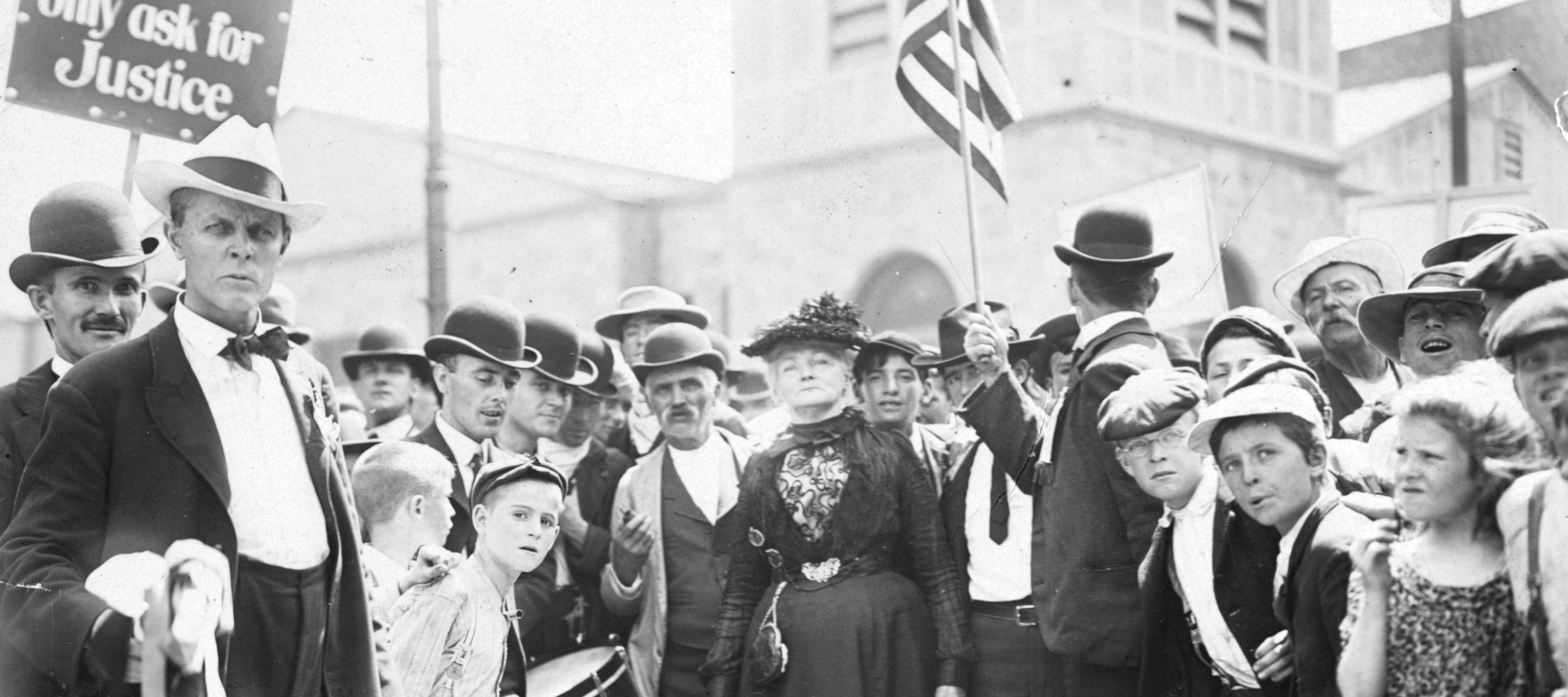
The failed promises of the industrial age were perhaps most pronounced in the Appalachian region in the United States, an area that stretches along the Appalachian Mountains from Southern New York to Northern Mississippi. Rich in materials and culture but economically poor, this region became home to “company towns,” small settlements of miners and their families who worked for a single company. Miners were often treated as dispensable. They were expected to labor long hours underground in potentially lethal conditions. There were no child labor laws and boys started work as young as 10. And there was no illusion of working for upward mobility: miners were often paid not in wages, but “scrips,” credit statements for goods and food valid only at stores owned by the mining company. There was nothing to save, and no way out. Hopeless, and living by the whim of company owners, Appalachian miners became vocal, sometimes violent proponents of unionization and working class solidarity.
By the turn of the 20th century, the wealth inequality and political corruption characteristic of the Gilded Age had become untenable. Various activist groups, soon collectively known as The Progressives, began demanding a democracy beholden to all, including workers, and a fair balance between the rights of business owners, workers, and consumers. Regularly led by women, the Progressive movement fought for child labor laws, fair working hours, public health regulations, consumer protections, and women’s suffrage. Other groups demanded anti-monopoly legislation, environmental regulation, and governmental policy informed by analysis and expertise. The Progressives found an ally in president Theodore Roosevelt, who advocated for a “New Nationalism” that placed both economic development and public interest as areas of concern, but it was only later, through Franklin D. Roosevelt’s New Deal, that much of the progressive’s demands were brought to fruition.
In this lesson, created in partnership with the Association for Cultural Equity, students gain a deeper understanding of what life might have been like for a working class person during this period of American history by examining the songs and stories of Nimrod Workman. Born in 1895, Workman began working in the West Virginia coal mines at fourteen years old, and continued for 42 years. By analyzing Workman’s songs and personal stories, which were recorded by Alan Lomax in 1983, students gain a first-hand account of one of the most dangerous, violent, and least regulated industries in American history, and discover the relationships between labor, industry, and the government from the 1890s to the end of World War II.