
90 mins
Almost Emancipated: The Civil War and the Port Royal Experiment
How does the Union occupation of Port Royal highlight the complex issues behind the Civil War?
Essential Question
How does the Union occupation of Port Royal highlight the complex issues behind the Civil War?
Objectives
Know (knowledge)
- About the Gullah/Geechee people of the Sea Islands and their unique culture
- The cause and progression of the Civil War
- About the Port Royal Experiment
- Abraham Lincoln’s Cooper Union Address
- The intents and effects of the First and Second Confiscation Acts and the Emancipation Proclamation
- The work of African American and educator Charlotte Forten
Mastery Objective:
- Students will develop an understanding of slavery as the key factor of the Civil War by examining primary source documents and listening to the music traditions of the Gullah/Geechee people.
Background
In this lesson, students learn about the Civil War and the Port Royal Experiment, a military reconstruction effort that demonstrates the possibilities that existed for the full citizenship and participation in society of newly freed African American populations in the Southern states. They will also consider the role the Sacred Song tradition of the Gullah/Geechee people who reside in the area surrounding Port Royal might have had during this moment in history.
The Gullah/Geechee are the unique African American inhabitants of the coastal Lowcountry of South Carolina and the Sea Islands, a 250-mile stretch of barrier islands on the coast of South Carolina and Georgia. Due to the relative geographic isolation of the islands, Gullah/Geechee culture remains a distinct microcosm of African American culture and history. Together with the Gullah/Geechee language and a sweetgrass basket weaving tradition, the culture is defined by its sacred song tradition. The community also shares a unique history, as the Sea Islands were the site of significant military and political developments during the Civil War.
While neither the Confederacy nor the Union declared the Civil War to be a war specifically about slavery, it is clearly the matter that drove the United States to war. The South went to war to preserve slavery. But the North did not go to war to end slavery; rather to preserve the Union. In a letter to Abolitionist Horace Greeley dated August 22 1862, Lincoln wrote, “If I could save the Union without freeing any slave, I would do it and if I could save it by freeing all the slaves, I would do it; and if I could save it by freeing some and leaving others alone, I would also do that. What I do about slavery and the colored race, I do because I believe it helps to save the Union; and what I forbear, I forbear because I do not believe it would help to save the Union.”
The nation’s economic dependence on the institution of slavery and the sheer number of enslaved African Americans living in the Confederate states made the question of whether slavery should persist central to national politics. The winner of a fraught 1860 election in which slavery was the deciding issue, President Lincoln held fast to the opinion that slavery should not be allowed to extend to the Western territories. So unpopular was Lincoln’s position on slavery in the Southern states that his name did not appear on Southern ballots. In December 1860, weeks after Lincoln was elected and before he was inaugurated, South Carolina seceded from the Union in a pre-emptive act to ensure that slavery would continue and could expand.
Once the Civil War began, Radical Republicans in Congress introduced confiscation acts which eroded the slaveholders’ claims to the enslaved people held as chattel. The First Confiscation Act (1861) gave the government the right to seize any enslaved person used for “insurrectionary purposes.” The Second Confiscation Act, passed in July 1862, extended the federal government’s authority over the property of secessionists convicted of treason. The provisions extended to freedpeople included the promise of transport and resettlement in “some tropical nation” that would accept those willing to emigrate. Further, the act prohibited the return of anyone formerly enslaved to bondage and allowed for freedmen to serve in the Union forces.
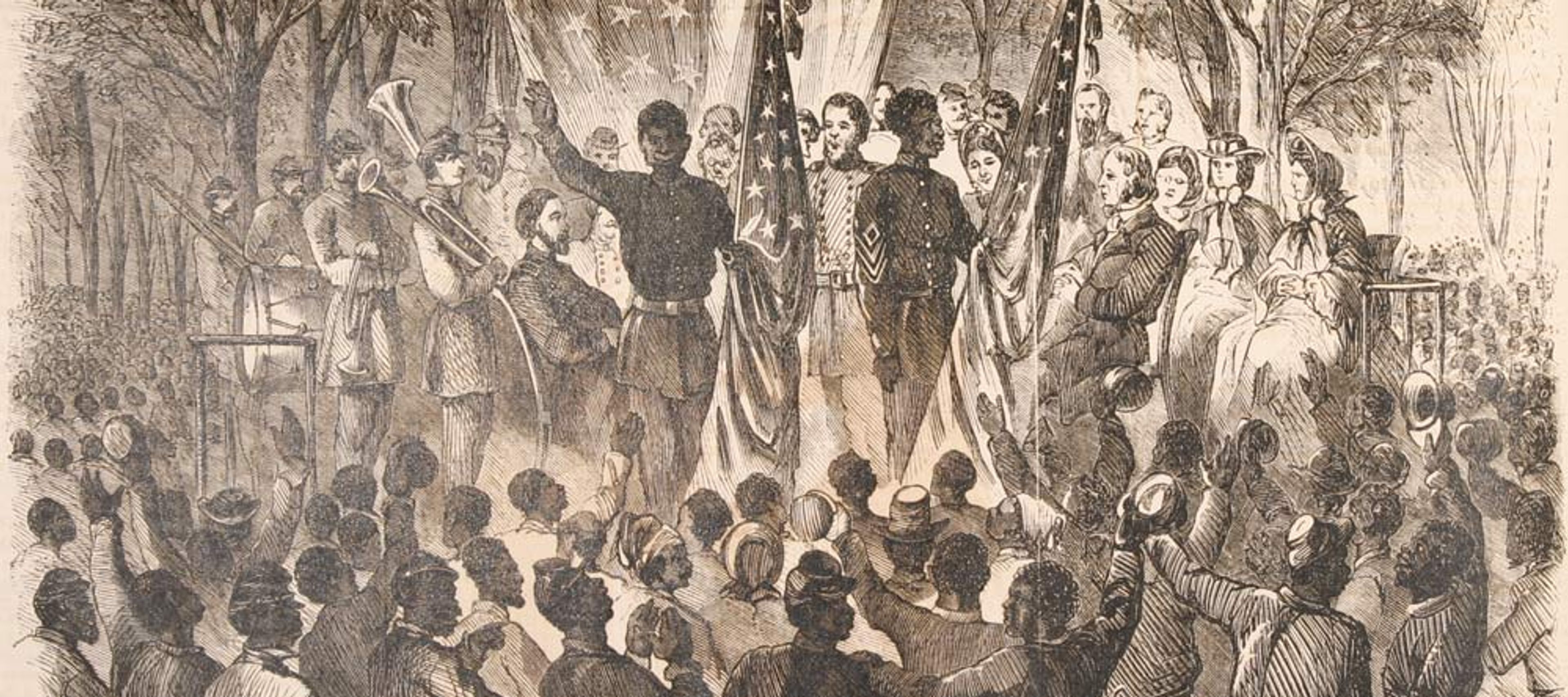
In November 1861, six months after the Civil War began, the Union Army took Port Royal, South Carolina. The strategically located port served as a base for patrol ships that prevented the Confederacy from exporting cotton and importing weapons. When the Union fleet arrived at the harbor, the plantation owners and civilians of the port city of Beaufort fled, leaving Confederate soldiers behind to defend the territory against the Union warships. The Confederate Army was quickly overwhelmed as they were outnumbered 5 to 1.
The Union Army occupied the city of Beaufort, freed approximately 10,000 enslaved Black people in the region by military decree and took control of the lucrative cotton trade that drove the local economy. The Union Army and Northerners filled the void left by their counterparts in the Southern ruling class, overseeing and profiting from the harvest and processing of that year’s cotton. Formerly enslaved laborers were hired and sheltered by the Union Army and received $1 for every 400 pounds of cotton harvested, becoming the first community of freedpeople to be paid for the same labor they had once done without compensation.
In January 1861, Union General Sherman requested teachers from the North to train formerly enslaved people. The resulting effort, known as the Port Royal Experiment, aimed to provide newly freed African Americans of the Beaufort area with schools and hospitals, and acted as a precursor to the period of Reconstruction after the Civil War.
Connected Themes
Genre(s)
Decade/Era
Monthly Theme