
90 mins
Almost Emancipated: Reconstruction
What is the significance of Reconstruction and what does it reveal about the freedom that the post-Civil War constitutional amendments secured for African Americans?
Essential Question
What is the significance of Reconstruction and what does it reveal about the freedom that the post-Civil War constitutional amendments secured for African Americans?
Objectives
Know (knowledge)
- About the Blues tradition of Mississippi
- About the The Bureau of Refugees, Freedmen and Abandoned Lands, otherwise known as the Freedmen's Bureau, and the role it played during the Civil War and the Reconstruction Period
- How the power structure of slavery required the exploitation of the free labor and sometimes the lives of the enslaved to create profit for the enslavers.
- That during Reconstruction African Americans exercised their right to vote and entered public service in significant numbers
- How African Americans’ attempts to claim the rights and protections which were theirs by law were met with resistance, terror and even death
- The significance of Juneteenth: June 19, 1865 in Galveston, TX
Mastery Objective:
- Students will be able to examine the ways that constitutional amendments affected the lives of formerly enslaved people and use primary documents to explore the ways that formerly enslaved people enacted their freedom and citizenship after the Civil War.
Background
In this lesson, students learn about Reconstruction and the challenges that African Americans faced when trying to embrace their full humanity and rights as citizens in the years immediately following the Civil War by exploring constitutional amendments, journalistic accounts and primary documents written by and about freedpeople during this time period. While Reconstruction (1865-1877) was an era of extreme violence, terror and disruption for African Americans living in formerly Confederate states, the music that forms the backbone of American popular music-- blues, work songs and spirituals-- survived and continued to develop during these years.
"It is true we have the Proclamation of January 1863. It was a vast and glorious step in the right direction. But unhappily, excellent as that paper is—and much as it has accomplished temporarily—it settles nothing. It is still open to decision by courts, canons and Congresses."
- Frederick Douglass “The Mission of War” (1864)
On June 18th, 1865, General Gordon Granger arrived in Galveston, Texas with 2,000 federal troops. He came to Texas with general orders to end slavery in the state, which was made illegal nearly two and a half years earlier thanks to the Emancipation Proclamation. Texas’ distance from Union territory, however, had made the Emancipation Proclamation nearly impossible to enforce, and the state became a destination for fleeing confederates who wanted to continue to profit by enslaving African Americans. Granger’s arrival in Texas is today celebrated as Junetheenth, a day commemorating the eradication of slavery the United States.
That Juneteenth occurred two and a half years after the Emancipation Proclamation is a testament to how wildly variable the process of emancipation and reconstruction were in the United States. Six months before Granger would arrive in Texas, freedpeople across the Atlantic Coast were being given 40 acre parcels of their own land for settlement and agriculture. As Abolitionist Frederick Douglass recognized in 1864, the legal rights freedpeople attained during and after the Civil War were only as good as Congress’s and the court’s ability to enforce them. The individuals and socio-political structures that benefited from slavery would not relinquish that power without a fight.
The reconstruction of the United States following the Civil War hinged on The Thirteenth Amendment, which prohibited slavery in all states and territories unless a person had been convicted of a crime. While Abraham Lincoln was the president when the Thirteenth Amendment was passed by the Congress in January 1865, he would be assassinated before it was ratified in December of the same year. During that year Vice President Andrew Johnson assumed the presidency, and inherited responsibility for carrying out the 13th Amendment. Lincoln added Johnson, a Democrat from Tennessee, to his ticket in an effort to keep Southern Democrats invested in the federal government. The widely divergent positions of Lincoln and Johnson, left imblanaced after Lincoln’s death, caused Reconstruction to become an unfulfilled promise.
In 1865, President Lincoln ignored the vigorous protests of many lawmakers who insisted that the African Americans should make their own way forward and created the The U.S. Bureau of Refugees, Freedmen and Abandoned Lands, commonly referred to as The Freedmen’s Bureau. The Freedmen’s Bureau was a massive federal bureaucracy created after the Civil War to aid people who had been enslaved and were now free. It offered services such as legal aid, food, housing and education. Efforts to reunite separated families and settle freedpeople on confiscated or abandoned Confederate lands also fell within the scope of work of the Freedmen’s Bureau.
Upon attaining the presidency, Johnson sought to disenfranchise the authority of the Freedmen’s Bureau and related military orders that benefitted freedpeople. In 1866, he reversed General Sherman’s Special Field Orders No. 15, which promised to allot land in South Carolina, Georgia, and Florida for the settlement of freedpeople, and returned the land to former enslavers. Johnson also attempted to veto Freedmen’s Bureau Bills, which expanded the authority of the Freedmen's Bureau and provided additional rights to freedpeople, including the right to land ownership and education.
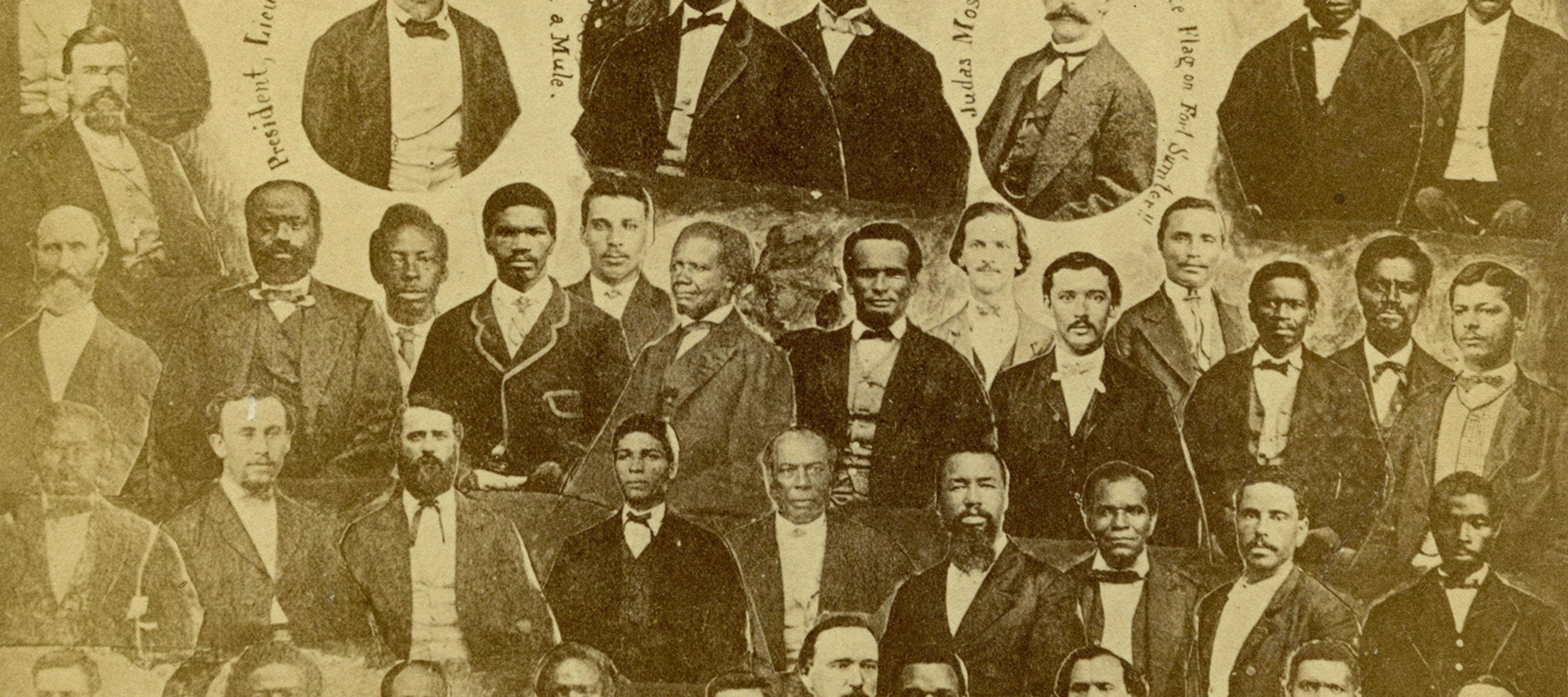
Johnson’s attempts to set back the reconstruction were met with mixed success. On March 2, 1867, Congress overrode President Andrew Johnson’s vetoes to pass a series of Reconstruction acts which would, among other things, establish new governments in the ex-Confederate states based for the first time on universal male suffrage. Perceiving an unprecedented moment of political opportunity, African Americans gathered in mass meetings throughout the South to plan their own agenda.
Laws prohibiting anyone elected to office in the Confederacy from serving in local or state government during Reconstruction created a power vacuum which the newly freed African American began to fill. By 1872, 1,510 African Americans held offices ranging from local municipal positions to multiple seats in the United States Senate . Eight black men served together in the U.S. Congress in 1875—a number that would not be matched until 1969, nearly a century later.
This progress and the pace at which it occurred drew significant backlash across the nation. In the former Confederate states, Black Codes were developed by the state and local officials that criminalized freedpeople, allowing them to be captured and put to work in labor camps and on prison work projects. The New Orleans Massacre of 1866 (also known as the New Orleans Riot) occurred when white residents attacked Black marchers gathered outside a meeting of the Louisiana Constitutional Convention, convened in response to the state legislature enacting Black Codes and limiting suffrage. Forty-eight people, forty-four of them African Americans, died in the violence and another hundred were injured. Throughout the South, threatening campaigns that ranged from pamphleting to the lynching of men, women and children would persist well into the twentieth century.
Connected Themes
Artist(s)
Genre(s)
Decade/Era