
90 mins
American Imperialism in the Philippines featuring ALAMAT
What was the justification and impact of American imperialism in the Philippines and how does ALAMAT’s music video “kasmala” reflect American imperialism in the Philippines?
Essential Question
What was the justification and impact of American imperialism in the Philippines and how does ALAMAT’s music video “kasmala” reflect American imperialism in the Philippines?
Objectives
Know (knowledge):
- The history of the Philippines prior to the Philippine-American War
- Justification for American imperialism in the Philippines
- The views of Americans who were pro-imperialism and those who were anti-imperialism
- The response of the Filipino people to American imperialism
- The treatment of Filipino immigrants in America
- The role of mass media, sensationalism, white supremacy, and propaganda in promoting American imperialism
- The impact of American imperialism in the Philippines
Mastery Objective
- Students will be able to explain the justification and impact of American imperialism in the Philippines through the examination of media and primary sources.
Background
In this lesson, students will explore the arguments for and against American imperialism in the Philippines through the analysis of speeches, political cartoons, and poetry. Students will analyze how sensationalism, white supremacy, and propaganda were used to justify imperialism in the Philippines through the examination of images from the music video for the song, “kasmala” by the Filipino pop group, ALAMAT, as well as other primary sources. Through the examination of these sources, students will be able to describe the impact of American imperialism on Filipinos and Filipino Americans.
The music group ALAMAT debuted in the Philippines with their first single “kbye” in February 2021. The once nine member group, now six, distinguishes themselves by singing in seven Philippine languages: Tagalog, Ilocano, Kapampangan, Cebuano, Hiligaynon, Bicolano, and Waray-Waray. The group members come from all over the archipelago and have a mission of inspiring Filipino pride through their music. ALAMAT blends the past and present by incorporating Filipino history, traditions, fashion, music, and dance with contemporary Pop music. The music video for their song, “kasmala” reflects the time period of American imperialism in the Philippines and prejudices against immigrants from the Philippines to America.
Before the Portuguese explorer Ferdinand Magellan laid the foundations for a Spanish colony in 1521, the Philippines consisted of extended kinship communities called “barangays”, groups of people that settled mostly around river deltas. These groups had their own social, political, and economic structures. However, they were also influenced by Indian, Chinese, Southeast Asian, and Arabian Peninsula cultures through trade and expeditions. After Magellan’s expedition and throughout the 16th Century, Spanish colonists worked to bring the local settlements under one centralized Spanish government by spreading Catholicism throughout the archipelago.
By the 1870s, unrest with Spanish rule started to manifest with the first Filipino national movement known as the Propaganda Movement. The Filipinos supporting this movement wanted the Philippines to become a Spanish province where its citizens had full Spanish citizenship rights. By 1896, the majority of Filipinos thought that the idea of citizenship was not enough and started the Philippine Revolution to fight for the end of Spanish colonial rule in the Philippines. The Philippine Revolution stalled when the Spanish-American War broke out in 1898 and the United States supported the Spanish colony of Cuba’s fight for independence. After a short war and a United States victory, the Spanish ceded the Philippines to the U.S. for 20 million dollars as part of the Treaty of Paris (1898).
The people of the Philippines had hoped the United States would help them obtain independence, but instead the U.S. took possession of the islands in a way that was reminiscent of Spanish colonial rule. There was much debate over colonizing the Philippines in America. Anti-imperialists stated that imperialism went against the democratic idea of self-governance. Other Americans saw the Filipino people as inferior, and they worried about immigration and the ramifications of interacting with Filipinos. Pro-imperialists used this same reasoning to justify colonizing the Philippines, saying it was the United States’ “burden” to civilize and spread culture to an inferior group of people. Additionally, other Americans were pro-imperialism for the economic advantages it would bring in Asian markets, and how it would further the United States’ power across the globe. Some pro-imperialist Americans used “manifest destiny” as a justification for colonizing the Philippines, saying it was the next step after the closing of the western frontier.
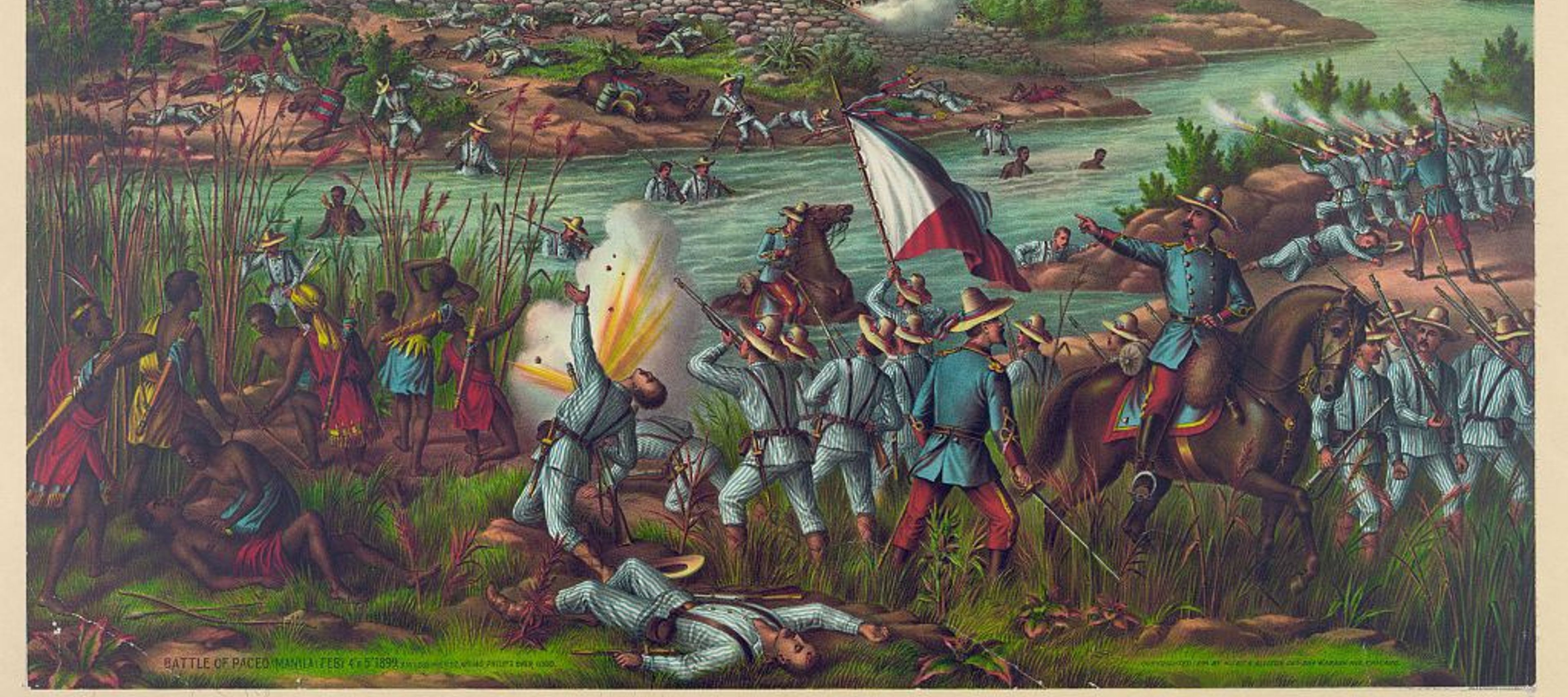
Ultimately, American pro-imperialist interests won out and the people of the Philippines, under the leadership of Emilio Aguinaldo, were fighting for their independence again, this time against the United States. The Philippine-American War lasted from 1899 to 1902, as revolutionaries in the Philippines fought for complete independence from the U.S. In 1901, Emilio Aguinaldo was captured, striking a blow to the Filipino resistance and leading to an eventual United States victory in 1902. The Philippines would remain a colony of the United States until 1946, when they achieved formal independence.
One justification for the colonization of the Philippines was promoted at the 1904 St. Louis World’s Fair, as seen in the ALAMAT music video, “kasmala”. Over 1,000 people from the Philippines were brought to America and taken to St. Louis for a Philippine exposition at the fair. The purpose of the exhibit functioned as a “human zoo” where attendees could witness what was proclaimed to be the “primitive and inferior” culture of the Philippines. The Igorot Village was one of the most popular attractions at the fair when it was discovered that the Igorot people consumed dogs in certain traditional practices. But the practice was twisted for shock value, and fair organizers forced them to eat up to 20 dogs a week in front of attendees. Other forms of sensationalism and propaganda included songs, photographs, and political cartoons that were used to portray the people of the Philippines as uncivilized and in need of saving.
The legacy of American imperialism is still present today in both the United States and the Philippines. During the time of American imperialism in the Philippines, many Filipinos migrated to the United States for work and were treated poorly after being offered the “American Dream”. These immigrants were denied citizenship and subjected to anti-miscegenation laws. After their formal independence in 1946, the Philippines was still entwined with the United States politically, economically, and militarily. The Americanized education system in the Philippines during the imperialist era contributed to a stripping of Filipino identity that had long lasting ramifications. Children were taught the U.S. Pledge of Allegiance and the Gettysburg Address, while their own history was portrayed through a westernized lens with the outlawing of the Filipino flag and the celebration of Philippine national holidays.
Disclaimers
This lesson contains primary source documents and other materials that may include terms and images reflecting the attitudes, perspectives, and beliefs of different times that today are considered offensive and demeaning. Teachrock.org does not endorse the views expressed in these documents, but recognizes the value such materials provide for historical inquiry. For guidance on introducing controversial historical materials into the classroom, we suggest reviewing this document from The Library of Congress.
Materials
- A device with access to the internet for each student.
Preparation
- Print copies (number dependent on class size) of Handout - Philippines Timeline for the group activity in Procedure step 3. Cut out each bullet point event and shuffle the order.
- Distribute digitally Kasmala Image Analysis Slides to students before class.
Connected Themes
Artist(s)
Genre(s)
Topics
Decade/Era
Monthly Theme