
90 mins
Bo Diddley: Bringing Rhythm to Rock and Roll
How were Bo Diddley’s recordings an anomaly in relation to 1950s Pop music, and how did his rhythm-driven sound and self-presentation serve as a model for popular music still today?
Essential Question
How were Bo Diddley’s recordings an anomaly in relation to 1950s Pop music, and how did his rhythm-driven sound and self-presentation serve as a model for popular music still today?
Objectives
Upon completion of this lesson, students will:
Know (knowledge):
- How Bo Diddley’s unconventional sound contrasted with popular music styles in the 1950s
- Hoodoo culture, as described by folklorist Zora Neale Hurston, and its connection with Bo Diddley’s recording of “Who Do You Love”
- How Bo Diddley's approach provided the foundation for popular music still today, especially Hip Hop
Mastery Objective:
- Students will be able to describe the foundational role Bo Diddley's musical approach played for developing popular music as it is known today by comparative music listening and lyrical analysis.
Background
In this lesson, students explore the particularities of Bo Diddley’s music, contrasting it with other artists of the late 1940s and early 50s, specifically John Lee Hooker's "Boogie Chillen," Chuck Berry’s “School Days” and The Chordettes’ “Mr. Sandman.” Through comparative listening, students will determine elements of Bo Diddley’s style, including his emphasis on rhythm and lyrical content, and examine how his recordings compared with the popular music of his peers. Then, students watch 1980s-era footage of Grandmaster Flash and the Furious Five, engaging in a guided discussion to draw conclusions as to whether they believe Bo Diddley can be viewed as a precursor to Hip Hop.
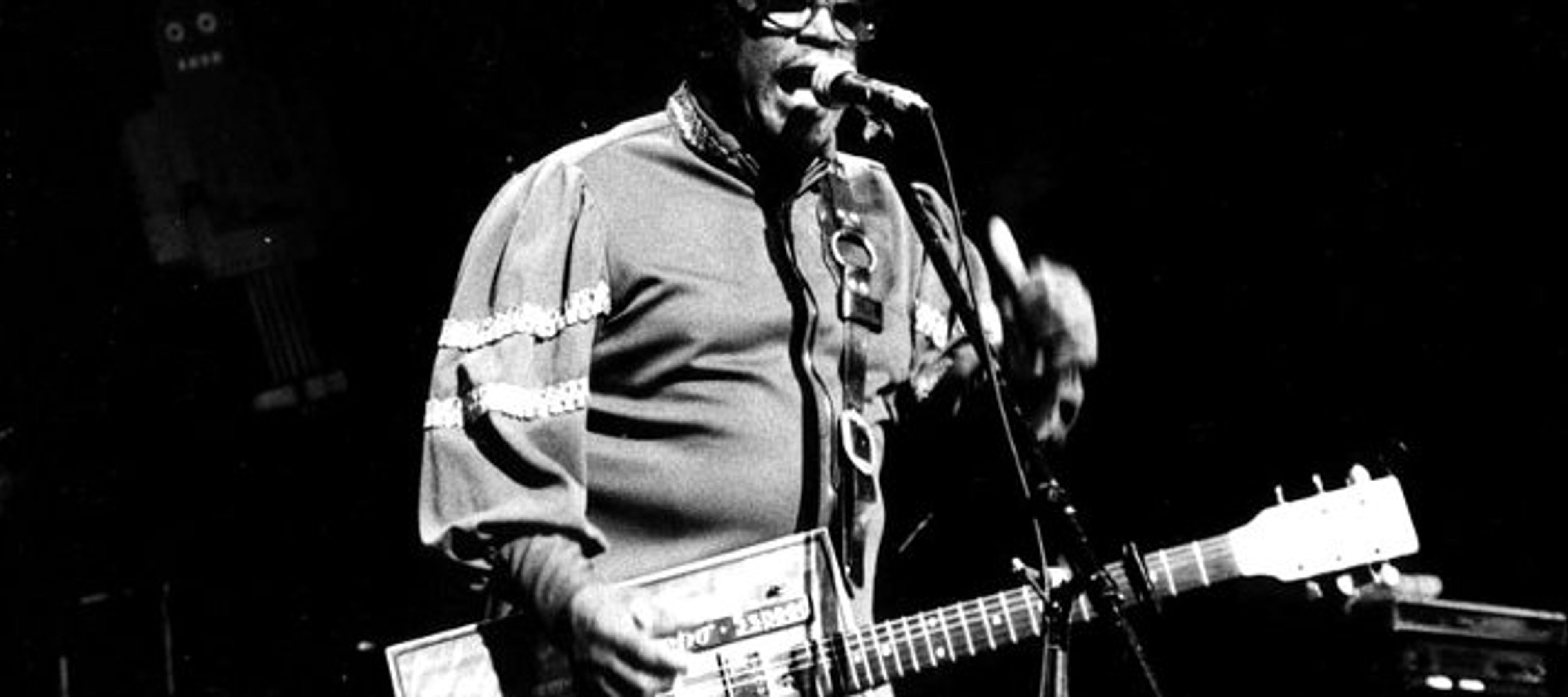
From his first appearance on the Billboard R&B chart in 1955 and continuing over his five-decade career, Bo Diddley has been celebrated for the rhythm-driven, percussive sound of his ensemble, at the center of which was Diddley’s guitar playing. If by the Rock era the guitar solo became a symbolic centerpiece in recordings and performances, Diddley's emphasis was always on the rhythm guitar. His approach didn’t revolve around the single- and double-note leads that came to dominate the music. Instead, Bo Diddley pioneered a sound that involved every member of his combo playing with a percussive sensibility. Rhythm was emphasized over melody, with a vocal style that often approximated Rap set against that rhythmic backdrop.
Diddley's approach soon became foundational to Rock and Roll - and later, Hip Hop. His best-known rhythm guitar pattern (three strokes/rest/two strokes, or “shave and a haircut, two bits”) influenced many. The “Bo Diddley beat,” as it came to be known, appeared on records by Buddy Holly, the Rolling Stones, Bruce Springsteen, U2, rapper B.o.B., and many others.
In Bo Diddley’s own songs, the “Bo Diddley beat” was often combined with remarkably simple chord changes, as can be heard on his self-titled debut single, “Bo Diddley.” Throughout that single-chord song, which went to No. 1 on the Billboard R&B chart in 1955, percussion takes clear precedence over melody or chord progressions. His emphasis on looped rhythm patterns, combined with semi-spoken, often boastful lyrics, paved a foundation for future Rock and Hip Hop approaches. In a 2008 article in Smithsonian Magazine, music historian Ned Sublette writes that Bo Diddley “was practically rapping anyway, with stream-of-consciousness rhyming over a rhythm loop.”
It was not just the “Bo Diddley beat” that set him apart however. Rather than singing about familiar images from postwar teenage life, as his labelmate Chuck Berry does on records such as “School Days” (1957), Bo Diddley’s lyrics explore more exotic territories. On his 1956 recording “Who Do You Love,” he sings about cobra snakes, human skulls, and tombstones -- symbols borrowed from the hoodoo rituals possibly recalled from his childhood in rural Mississippi, before his family moved north to Chicago in 1934. These images drawn from a black southern culture well beyond the boundaries of mainstream American life.
Connected Themes
Artist(s)
Topics
Decade/Era
Monthly Theme