
90 mins
Cleaning up the Plastic Beach
How is plastic made, how does it affect our marine environments, and how can plastic waste be eliminated?
Essential Question
How is plastic made, how does it affect our marine environments, and how can plastic waste be eliminated?
Objectives
Know (knowledge):
- About the creation, history, chemical makeup, and use of plastics
- About the impact plastic waste has on the environment and on health
- How to visually illustrate plastic molecules
- How various actions are being taken to curb plastic waste
- How students themselves might become involved in fighting plastic waste
Mastery Objective:
- Students will be able to develop action plans to curtail plastic waste by learning about the environmental threats posed by plastics and by assessing existing projects that seek to eliminate plastic waste.
Background
For an elementary school level version of this lesson, click here.
After completing the chart-topping album Demon Days, Damon Albarn didn’t know what to do next with Gorillaz, the animated band he created with illustrator Jamie Hewlett. He came close to retiring Gorillaz altogether, and creating a new virtual cast of characters. But then, an ordinary observation unexpectedly set off a spark of inspiration.
In an interview with journalist Paul Morley, Albarn recalls he was watching the beach next to his house in Devon, England, and saw plastic debris washing up on the shore. “Just looking at all the plastic within the sand,” Albarn said, “That’s where it came from.” Soon, Albarn and Hewlett relocated the Gorillaz to a fantastical studio built on an island of accumulated plastic trash, in the middle of the ocean. The ambitious Plastic Beach project was born, complete with an album, animated films, and books. Collaborators ranged from De La Soul, Lou Reed, Snoop Dogg, Bobby Womack, Mick Jones, and Paul Simonon.
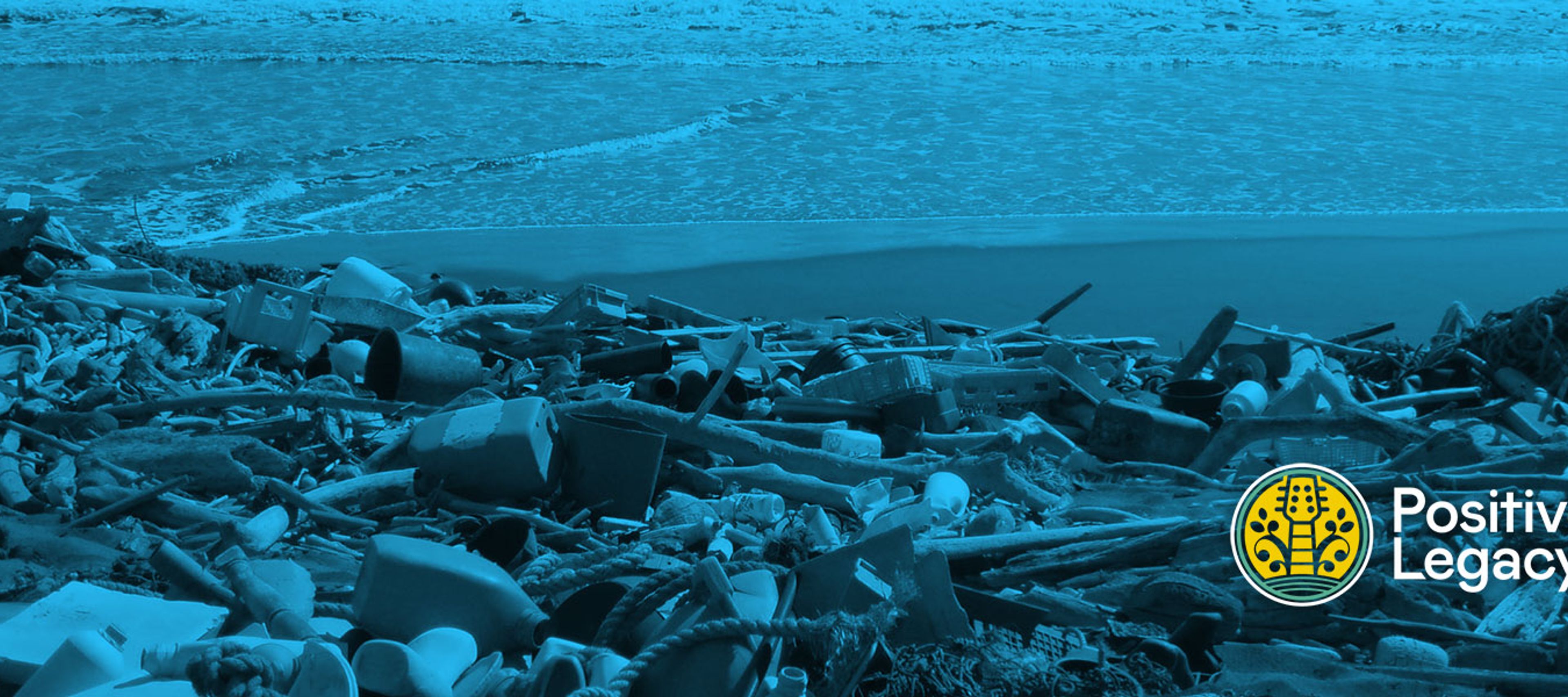
This origin story of Plastic Beach is more a testament to Albarn’s creative mind than serendipity. Seeing plastic on a beach today is not a rare occurrence: currently, there is approximately 6.9 billion tons of plastic waste on earth, 6.3 billion of which has never made it to a recycling plant. Discarded plastic bottles, shopping bags, and other disposable containers float in our rivers and oceans, and are washed upon our shores. Besides ruining the beauty of our waterways and beaches, this plastic waste may pose threats to the heath of our planet. Plastics in the ocean are broken down into very small pieces called microplastic, which are then eaten by marine life. The health effects of consuming such chemically-produced microplastics are still unknown, but what is known is that microplastics are now everywhere, from the insides of fish to sea salt to human excrement. On some beaches on Hawaii’s Big Island, up to 15% of the sand is actually microplastic.
The plastic waste crises can only be said to have been caused by one thing: humanity’s irresponsible use of great scientific and technological innovation. The invention of plastic in the late 1800s, and its mass production in the mid-1900s, has improved the world in multiple ways. It has revolutionized medicine, made transportation lighter and more energy efficient, made food easier to transport across the globe, and made space travel possible. Yet, the remarkable qualities plastic offers, coupled with it’s ease and affordability to produce, has also created a disposable culture. Today, roughly 40 percent of plastics produced every year is single-use: bags, straws, bottles, and other packaging that is used on average for less than an hour before being thrown away. If not recycled, scientists say these plastics will take 450 years or longer to fully decompose.
Thankfully, every day more people are becoming aware of the plastic waste problem, and are tackling the issue in many ways. National bodies such as Chile, China, Kenya, and the E.U. has enacted legislation to ban single-use plastics, while many multinational corporations are phasing out non-recyclable plastic products. Scientists are developing new plastics that dissolve on demand, and biodegradable plastics are increasingly available to consumers. Engineers are creating marine collection units to gather plastic waste before it breaks down into microplastic, and celebrity activists such as SZA are creating sustainable fashion lines that spread awareness about disposable synthetic clothing. There are also some signs that the disposable culture is changing from the ground up, as people are increasingly using social media to share the ways they are cutting down on waste.
In this lesson, the music and visuals of the Gorillaz album Plastic Beach is used to introduce students to the issue of plastic waste. Students are asked to calculate the percentage of plastic that goes unrecycled internationally, and illustrate a model of polyethylene to better understand why the molecular makeup of plastic creates both benefits and drawbacks. Finally, they evaluate various projects that are currently being undertaken to curb plastic waste, and develop their own similar program or project that they could employ on a local level.
This lesson made possible in part by Leaving a Positive Legacy, Inc. Positive Legacy is a 501c3 nonprofit that integrates music and service to benefit people and the planet.
Materials
- Colored pencils
- Sketch paper