
90 mins
Counterculture in the 1960s
How did the counterculture movement of the late 1960s challenge traditional American behaviors and values, and how did the Grateful Dead reflect these changing views of life and society?
Essential Question
How did the counterculture movement of the late 1960s challenge traditional American behaviors and values, and how did the Grateful Dead reflect these changing views of life and society?
Objectives
Know (knowledge):
- The “mainstream” social and cultural environment of the 1960s
- The dominant beliefs and actions of the counterculture of the late 1960s
- The writing of Herbert Marcuse
- The historical significance of San Francisco’s Haight-Ashbury neighborhood
- Journalistic accounts of Haight-Ashbury by Ralph J. Gleason, Tom Wolfe, Joan Didion, Hunter S. Thompson, and Warren Hinckle
Mastery Objective:
- Students will be able to define the idea of “counterculture” and apply it to the present moment by examining journalism, literature, and music of the 1960s.
Background
After World War II, The United States entered into a period of enormous economic growth and prosperity that lasted until the early 1970s. While the war was over, the perceived threat of communism resulted in escalated military spending, which led to the development of many new technologies and industries. In addition, the U.S. government continued to invest in social projects such as public schools, housing, highways, welfare, and veterans benefits that stimulated growth. Unions, a major influence in the US labor market following the support of the Franklin D. Roosevelt administration, were able to successfully negotiate fair wages for workers. As a result, millions of Americans gained access to meaningful employment, invested in homes, and stocked them with families and new commodities. After a long period of declining births, the post World War II era saw the birth rate skyrocket and the nation’s population rose almost 20 percent. The generation now known as the “Baby Boomer” was born.
There were some, however, who were troubled by the consumption during this “Golden Era of Capitalism.” Perhaps the most poignant and detailed critiques came from a group of German scholars collectively known as the Frankfurt School. Having experienced the Holocaust first-hand, Frankfurt School critics like Herbert Marcuse, Max Horkheimer, and Theodor Adorno feared that the consumerist society of the 1950s wasn’t liberating people, but rather acting as a means of social control. For them, TV shows, popular music, and the newest dishwasher were nothing more than a way to placate the masses, and keep the average Westerner distracted and uninterested in thinking critically about rampant militarization and a world that was spiralling ever closer to nuclear war.
By the time the Baby Boom generation was coming into adulthood in the mid 1960s, the Frankfurt School’s criticisms had begun to garner more attention. Many of the young adult “Boomers”became disenchanted with the types of consumption valued by their parents’ generation and began seeking new experiences, experimenting with varied modes of thought and styles of living.
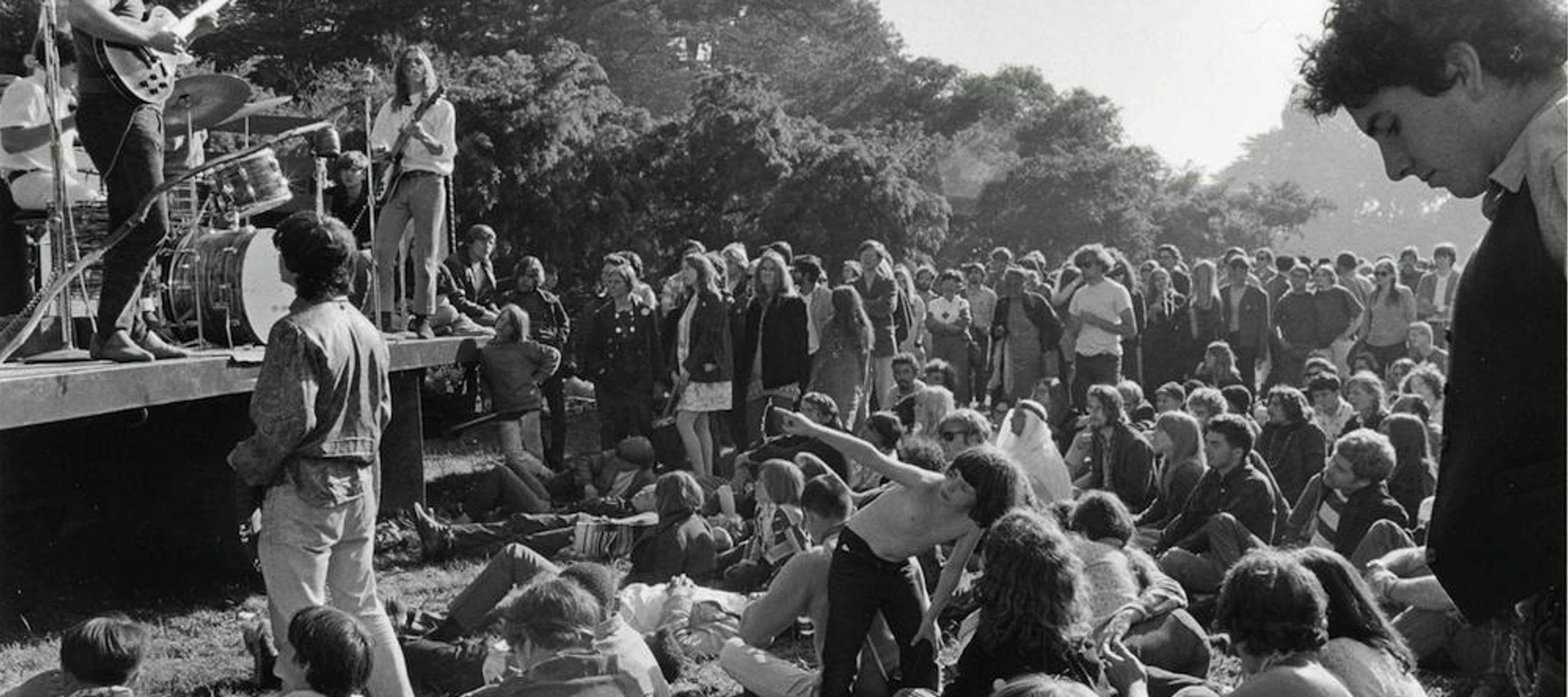
One of the most famous of such experiments culminated at Haight-Ashbury, a district of San Francisco, California. Between 1965 and 1967, young people from across the country arrived to Haight-Ashbury, drawn in by cheap rent and the bohemian reputation of the neighborhood established largely by the various artists of the Beat era. A vibrant counterculture developed, made up of a community of what some would later refer to as “hippies,” people who rejected the pressure to live as workers, earners, and consumers within a singular family unit. During this era, many in Haight-Ashbury embraced the possibilities of nearly anything perceived as outside the mainstream, including communism and communal living, open relationships and sexual liberation, various elements of Eastern religions, and psychotropic drugs such as LSD and peyote. And, of course, music.
Rock and Roll was the primary musical language of Haight-Ashbury, and in the hands of its inhabitants, the music became experimental and careened outside its previous bounds. Free concerts proliferated in San Francisco’s Golden Gate Park and on the city’s streets, while venues such as the Matrix and the Fillmore showcased bands that personified the “San Francisco Sound”: Jefferson Airplane. Quicksilver Messenger Service, Big Brother and the Holding Company, and others. The band that came to most represent this moment in Haight-Ashbury, however, was the Grateful Dead.
While the Grateful Dead and their fans maintained some elements of countercultural ideals well into the 1990s, much of the idealism of Haight-Ashbury as a utopian location did not survive the 1960s.. Following the publicity of the 1967 “Summer of Love,” thousands flocked to the neighborhood, overrunning the area, and, in the language of the day, “burning out.” American corporations saw the value of “flower power,” and absorbed key elements of the movement for marketing purposes, turning much of it into nothing more than a fashion trend that could be found in stores across America. Record companies too saw opportunity, and some of the San Francisco bands ultimately became the Top-40 artists they were so critical of earlier in their careers. Some suggest that by the time the country embraced the counterculture, it was already over.
In this lesson, students explore the significance of the Haight-Ashbury in the 1960s by watching clips from the documentary Long Strange Trip and reading journalistic accounts of the hippie movement in that neighborhood. They then debate the significance of the countercultural scene: were hippies trying to change American society, or simply escape it?
Disclaimers
Note to teacher: The primary sources used in this lesson contain passing reference to drug use. Teacher discretion advised.