
90 mins
Distortion: The Sound of Rock and Roll’s Menacing Spirit
What is distortion, and how did it become a desired guitar effect in Rock and Roll?
Essential Question
What is distortion, and how did it become a desired guitar effect in Rock and Roll?
Objectives
Know (knowledge):
- How to identify the sound of distorted guitar in a recording
- Key figures, events, and recordings in the evolution of distorted guitar as a defining sound in Rock and Roll
- How a distorted electronic signal looks in comparison to a non-distorted signal
Mastery Objective:
- Students will be able to explain why distorted guitar is a defining characteristic in Rock and Roll and how it was achieved.
Background
On a late winter day in March 1951, a carful of teenage musicians headed toward their first recording session in Memphis, Tennessee. Short on space inside the vehicle, the band had tied much of their equipment to the roof, including their guitar amplifier, which at one point came loose and tumbled to the ground.
Upon setting up at the recording studio, the band’s guitarist Willie Kizart discovered that, though the fallen amp still functioned, it made his guitar sound distorted and “fuzzy.” There were no other amplifiers to use, and the excited young men weren’t going to let a technical malfunction ruin their day. They recorded anyway, fuzzy guitar and all.
That session produced “Rocket 88,” considered by many the first Rock and Roll recording, and Kizart’s “distorted” guitar was an essential component. Engineered by Sam Phillips at his Memphis Recording Service studio, the song was released via Chicago’s Chess Records label and quickly became a Number One hit. Though credited to Jackie Brenston and his Delta Cats, the group was actually the Mississippi-based Kings of Rhythm, led by future Rock and Roll Hall of Famer Ike Turner.
Only months later in July 1951, another band from Mississippi made its way to Sam Phillips’ Memphis studio. This time Phillips recorded guitarist Willie Johnson’s snarling six-string on Howlin’ Wolf’s “How Many More Years.” But Johnson’s aggressive guitar tone wasn’t due to a mechanical mishap. The guitarist was intentionally pushing the limits of his amplifier’s power toward the brink of destruction, creating a seriously fuzzy sound.
Like “Rocket 88,” “How Many More Years” was a Chess Records release and became a major hit on the Rhythm & Blues chart. While the songs’ success primed listeners’ ears to the sound of distorted guitar, it would be several years before this byproduct of frazzled equipment would become a defining feature of Rock and Roll. First, another pioneering song would cause a far-reaching rumble.
Released on Cadence Records in 1958, Link Wray’s instrumental “Rumble” was created during an impromptu jam at a show in Fredericksburg, Virginia. Electrified by the song as it came to life onstage, the audience worked itself into a frenzy. Seeking to hear Wray’s guitar over the din of the excited crowd, a microphone was placed in front of his amplifier. The instrument crackled with distortion as it blasted through the venue’s public address system.
Later, on the recording session for the song, Wray couldn’t get that same sound. He grabbed his amp, punctured the speakers, plugged in, and let it rip. It worked. Wray’s amplifier emitted a distorted growl, conjuring up the sonic spirit heard when the tune first lurched into existence. Although banned from airplay in certain markets out of concern that the track would inspire teenage delinquency, the song was a hit.
“Rumble” helped define the sound of the electric guitar, and to many, Wray’s distorted chords instilled a menacing spirit in the emerging Rock and Roll persona. As distortion became a sought-after guitar sound in Rock and Roll, the ability to reliably reproduce the effect without breaking equipment had to be achieved.
In 1960, Nashville recording engineer Glenn Snoddy was working with Country artist Marty Robbins when a strange sound filled the studio. Snoddy noticed that session guitarist Grady Martin’s solo on the song “Don’t Worry” was distorted due to a damaged component in the mixing console. The guitar’s tone was fuzzy.
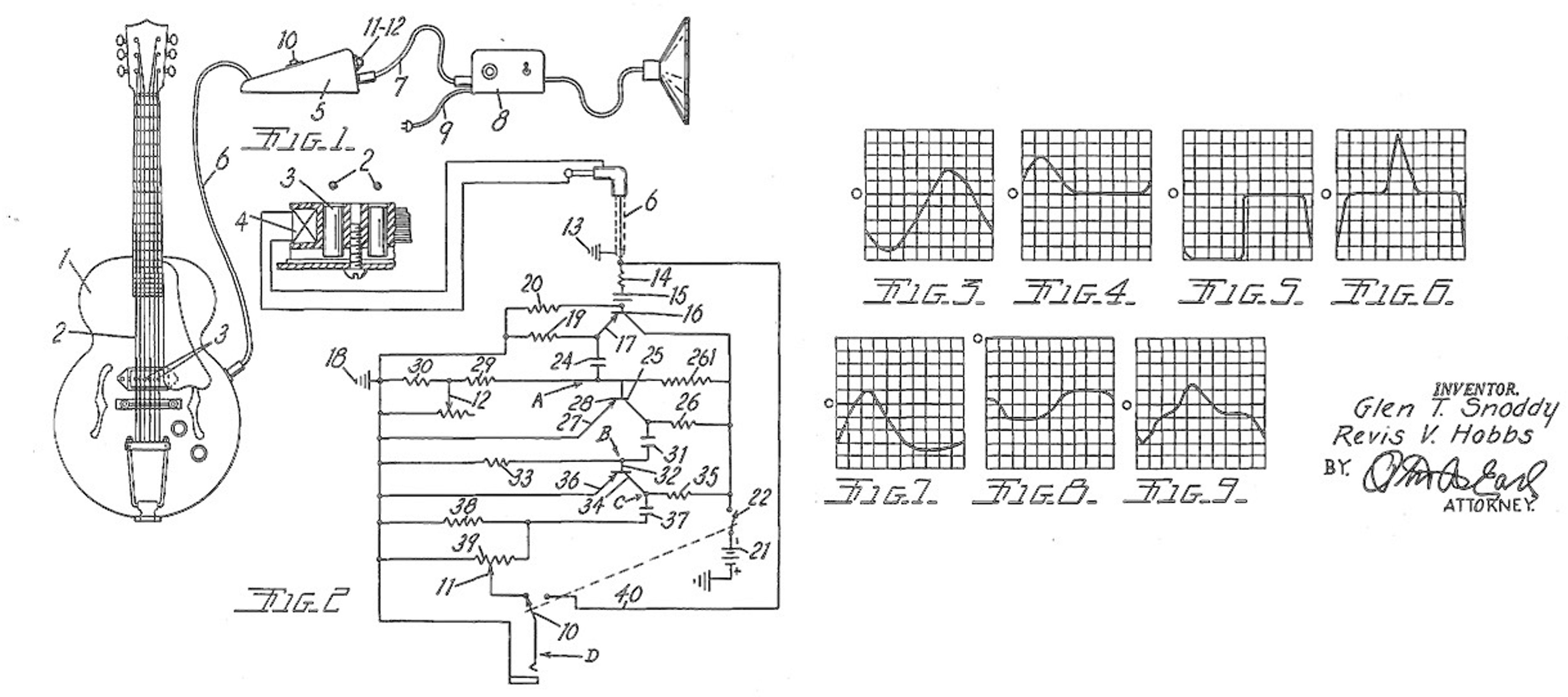
Inspired by the experience, Snoddy and fellow Nashville audio engineer Revis Hobbs developed and patented a prototype distortion effect box. They sold the design to the musical instrument company Gibson, who marketed it as the Maestro Fuzz-Tone guitar pedal. The Fuzz-Tone, however, failed to catch on until the pedal got into the hands of a Rolling Stone.
During the Rolling Stones’ Spring 1965 U.S. tour, Gibson furnished the band with amplifiers and a couple Fuzz-Tone pedals. When the group was in Los Angeles, they recorded their next single, “(I Can’t Get No) Satisfaction.” Rolling Stones guitarist and songwriter Keith Richards used his newly acquired Fuzz-Tone pedal to record the tune’s iconic single-note guitar hook. The song was an immense success and brought distorted guitar to the ears of a global audience. Encapsulated in a pedal, now the Rock and Roll spirit that distortion conveyed was available to all with the push of a button.
In this lesson, students will listen to recordings that illustrate how guitar distortion evolved into a defining sound in Rock and Roll. Students will examine key events in the development of the effect and use a techtool to compare and contrast the sound of a guitar when distortion is in the electronic signal path and when it is not.
Connected Themes
Topics
Decade/Era
Monthly Theme