
90 mins
Drawing to Music
How might visual artists use music as a tool for inspiration, and how might sound be reflected through art?
Essential Question
How might visual artists use music as a tool for inspiration, and how might sound be reflected through art?
Objectives
Know (knowledge):
- What synesthesia means in the context of art
- How to use the senses as a tool for inspiration
- Basic elements and principles of art
- About the artist Wassily Kandinsky
Mastery Objective:
- Students will be able to demonstrate the role of the senses in visual art and synesthetic principles through drawing to music, and critical analysis of the works of Wassily Kandinsky.
Background
The word “synesthesia” comes from the Greek syn and aisthesis, which can be translated as “together” and “sense,” or “join” and “perception”. Both translations offer a good description of what the neurological condition of synesthesia embodies: a unity of senses that results in the experience of one sense when another is stimulated.
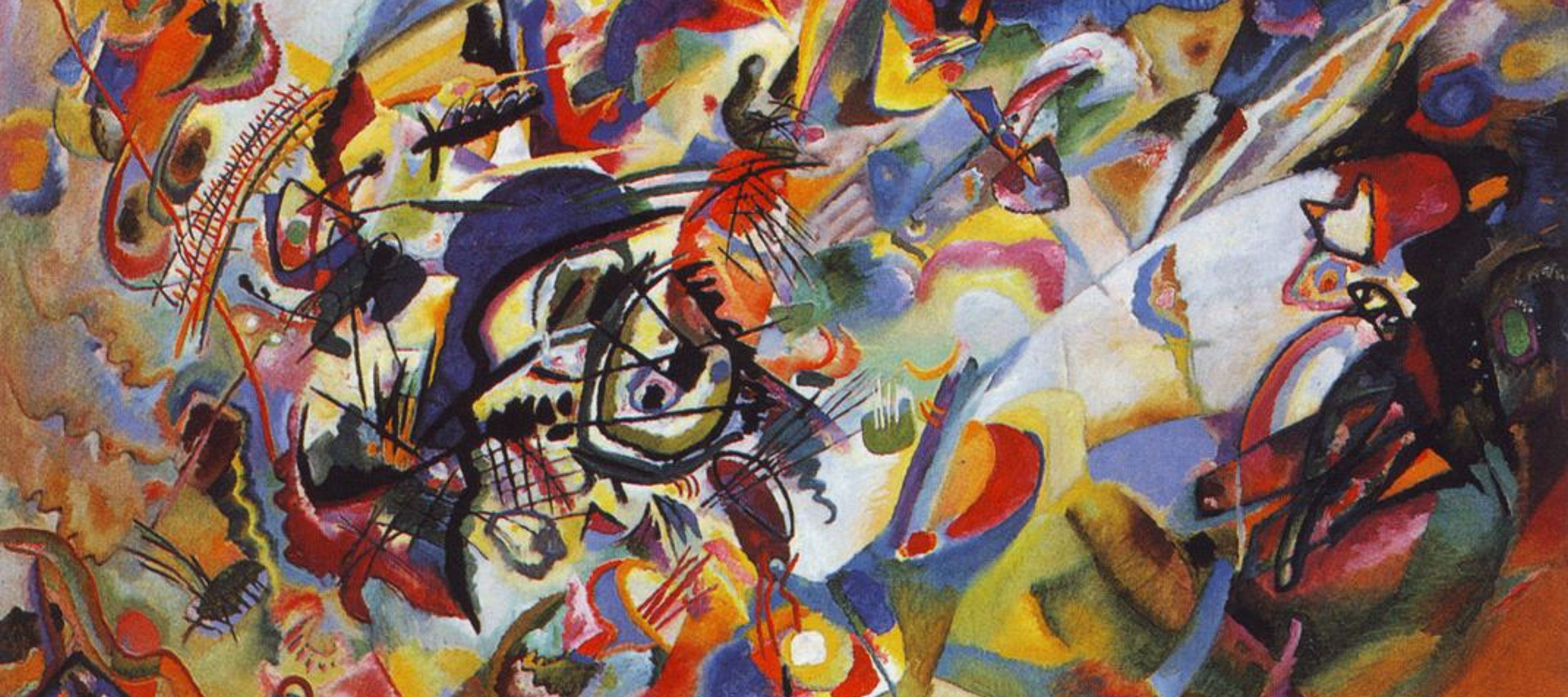
Many believe the groundbreaking Russian abstract painter Wassily Kandinsky was a synesthete. Kandinsky’s work explored his multi-sensory perception of color and music, which he termed a “joined perception” of sight and sound. “Kandinsky literally saw colors when he heard music, and heard music when he painted,” explains the Denver Art Museum’s Renée B. Miller, “he deployed color, line, shape, and texture to create a rhythmic visual experience that evoked an emotional response.”
While describing Kandinsky, Miller evokes several basic principles and elements of art—color, line, shape, texture, and rhythm—all of which have parallel meanings in music. Indeed, the “joined perception” of synesthesia has empowered not only artists such as Kandinsky and Van Gogh, but also musicians including Franz Liszt, Duke Ellington, Pharrell Williams, Lady Gaga.
In this lesson, students explore the principles of synesthesia through drawing to music. By viewing and analyzing artwork based on multi sensory perception, students will become aware of the role of the senses in art, and how sensory stimulation—such as listening to music—can be used as a tool for inspiration. Guided by a handout outlining the basic elements and principles of art, students will engage in active discussions about how sensory perceptions can be interpreted through color, line, and form. They will then apply these reflections on their own artistic work.
Slides
Connected Themes
Artist(s)
Genre(s)