
90 mins
How a Bill Becomes a Law: Legislating the Martin Luther King, Jr. Holiday
How does a bill become a law in the United States of America?
Essential Question
How does a bill become a law in the United States of America?
Objectives
Know (knowledge):
- How the United States Constitution established the federal system of government and its related institutions
- The powers and roles of the Legislative and Executive branches in the process to enact laws in the United States
- The history to enact the Birthday of Martin Luther King, Jr. holiday
- About the origins of Stevie Wonders’ song “Happy Birthday.”
Mastery Objective:
- Students will be able to explain how laws are enacted in the United States by examining the campaign to establish the Birthday of Martin Luther King, Jr. holiday.
Background
In this lesson, students identify how a bill becomes a law in the United States by analyzing the Constitution and exploring how an organized public campaign applied pressure on elected representatives to enact the Birthday of Martin Luther King, Jr. federal holiday.
The constitutional process for a bill to become law in the United States is a fundamental exercise of the nation’s democratic system of government. Enacting laws features the distinct roles and vested powers of two of its three institutions, the Legislative and Executive branches. A bill can originate in either chamber of the Legislative Branch, the House of Representatives or the Senate. It must move successfully through debate in various committees before finally securing a majority of votes in both legislative chambers of Congress. The bill then proceeds to the Executive Branch, where the president can take a variety of actions.
Typically, a president will choose one of two courses of action: either sign the legislation into law or decline to sign and return the unsigned bill to Congress (known as a veto). While Congress does have the additional power to override a presidential veto with a two-thirds majority vote in both chambers, this is a rarely used legislative measure to enact laws. Presidents may also choose to take no action on a bill that is presented for signature. If Congress remains in session for ten days after the bill has been presented to the president and it has not been signed or vetoed, the bill becomes law. However, if Congress goes out of session within ten days of the bill being presented to the president and no action has been taken to either sign or veto, the bill does not pass. This is known as a “pocket veto.”
An important variable in creating new laws is direct democracy - the involvement of the public. Public pressure on elected representatives to act on a particular issue can play a substantial role in a bill becoming a law. Furthermore, history has shown that when an issue gains support from a leading public figure who can garner coverage by the media, favorable public awareness toward the issue can be raised even further, resulting in government leaders being more inclined to respond with legislative solutions. Such was the case for a bill marking the birthday of Dr. Martin Luther King, Jr., a yearslong organized public awareness campaign coordinated with the support of a celebrity finally led to the bill being signed into law. But the journey to that triumph had taken over fifteen years, and the first steps were taken just days after the tragedy of Dr. King’s murder.
In the immediate aftermath of Dr. King’s assassination on April 4th 1968, U.S. Congressman John Conyers of Michigan introduced the Conyers King Holiday Bill in the House of Representatives. Submitted four days after King’s death, the legislation sought to establish a federal holiday to honor the slain civil rights champion; however, Representative Conyers’ bill languished in congressional committees for years even though he dutifully submitted his legislation at the beginning of every new congressional session. Contributing to the delay was the fact that King was not viewed favorably at that time by many members of Congress, nor among a substantial portion of the American public.
Finally, in 1979, the Conyers’ bill was voted on in Congress but fell five votes shy of passage. Undaunted, the King Center in Atlanta, led by Dr. King’s widow Coretta Scott King, continued to lobby for a national holiday. They were soon joined by a powerful ally, musician and songwriter Stevie Wonder. In 1980, Wonder channeled his discontent with opposition to the holiday into “Happy Birthday,” a song that completely reimagined the traditional song and featured lyrics celebrating Dr. King’s peaceful mission. “Happy Birthday” became an international hit in 1981 and an anthem for the campaign.
The popularity of the song substantially increased awareness of the campaign, resulting in increased public support of enacting the new law. By the end of 1982, the King Center had gathered six million signatures on their petition in support of federal legislation to establish a Dr. King federal holiday. Mrs. King and Mr. Wonder presented the signed petition to Massachusetts Congressman Tip O’Neill, Speaker of the House of Representatives.
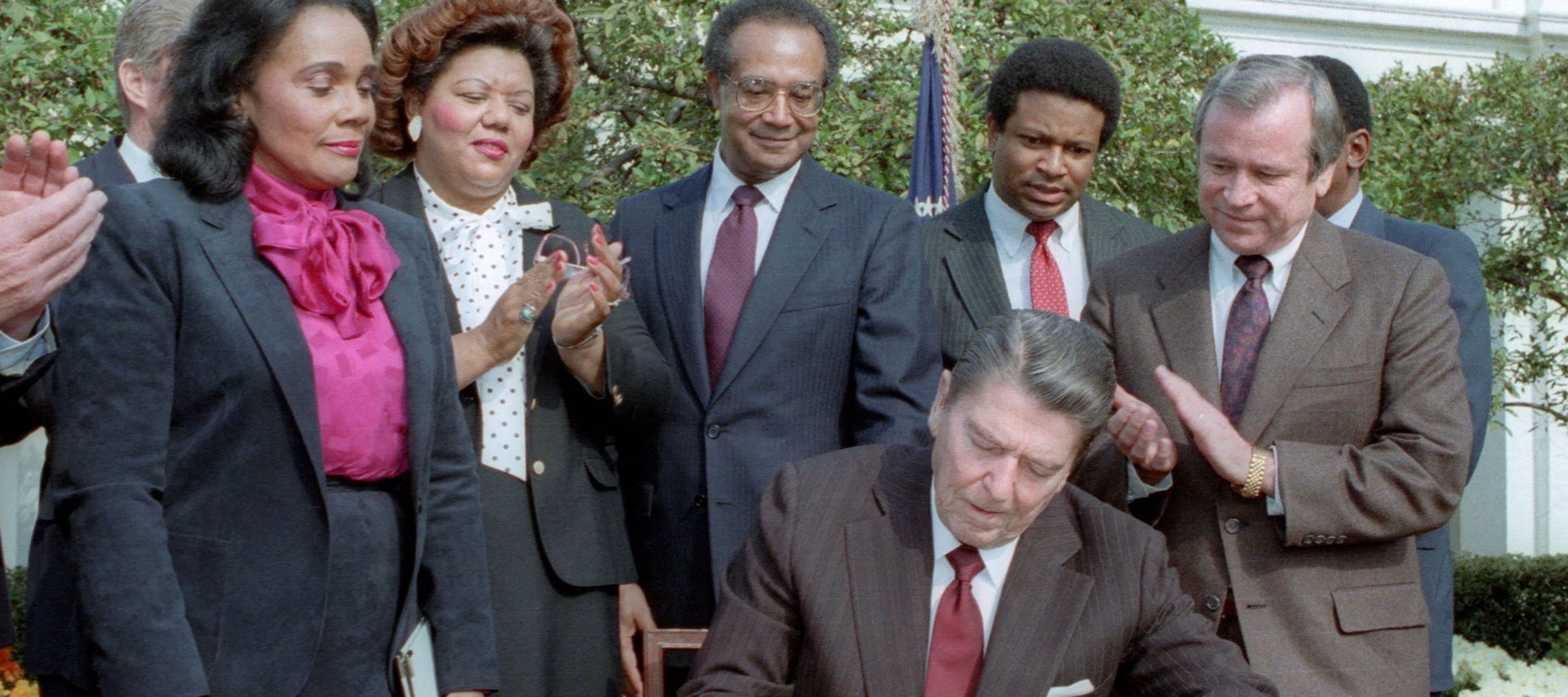
A new bill, House Resolution (H.R.) 3706, authored and sponsored by Representative Katie Hall of Indiana, was submitted to the 98th Congress on July 29, 1983. Although it was met with opposition in both the House and Senate, a bill “to make the birthday of Martin Luther King, Jr., a legal public holiday” passed both chambers of Congress. H.R. 3706 was signed into law by President Ronald Reagan on November 2, 1983 at a White House ceremony with members of the Dr. King’s family present.
Connected Themes
Artist(s)
Genre(s)
Decade/Era
Monthly Theme