
90 mins
Japanese American Internment featuring Kishi Bashi
How did Japanese American veterans experience Japanese internment during World War 2, and how did music grant them resilience during this historic injustice?
Essential Question
How did Japanese American veterans experience Japanese internment during World War 2, and how did music grant them resilience during this historic injustice?
Objectives
Know (knowledge):
- How a history of prejudice against Japanese Americans culminated in their internment during World War II
- The experiences people had being part of the internment program
- How music and arts were used as a mode of resilience towards Japanese internment
- The effects of Japanese internment
- How musicians continue to draw meaning from the period of Japanese internment
- The differences between primary and secondary historical sources, and how they benefit historical inquiry
Mastery Objective
- Students will be able to identify how primary and secondary sources provide insight into the period of Japanese internment by listening to podcasts, examining oral histories, and viewing photographs.
Background
In this lesson, students compare the benefits and drawbacks of primary and secondary sources by analyzing the history of Japanese Internment. They listen to excerpts from the podcast Asian American History 101 to learn the history of Japanese Americans. They then analyze a variety of primary sources on Japanese Internment, including oral histories from the Library of Congress’ Veterans History Project, photographs of the Manzanar internment camps by Ansel Adams, and written accounts of life in the internment camps collected and published by Dr. Minako Waseda. As a concluding activity, students examine the work of contemporary musician Kishi Bashi, and discuss how primary and secondary sources from multiple perspectives help illuminate difficult moments in the history of the United States.
On August 10th, 1988, Congress passed Public Law 100-383, otherwise known as the Civil Liberties Act of 1988. Signed into law by President Ronald Reagan, the Act acknowledged that the “evacuation, relocation, and internment” of Japanese American civilians during World War II was in fact not motivated by security concerns, but rather “by racial prejudice, wartime hysteria, and a failure of political leadership.” As means of restitution, the bill also granted payments of $20,000 for all citizens formerly incarcerated in the camps.
Like all acts of racial prejudice, the forced removal of Japanese American citizens into internment camps during World War II was not an isolated incident, but rather the culmination of a long history of racial discrimination directed towards Japanese immigrants, especially on the West Coast.
Immigrants from Japan first began arriving in large numbers to the United States following the passage of the Chinese Exclusion Act of 1882. With Chinese immigration effectively banned in the country, businesses began searching for other means of cheap labor. This need, combined with more lenient emigration policies in Japan by the second half of the 19th century, led to a substantial number of Japanese families immigrating to the United States - particularly in Hawaii and later, to the West Coast.
In the United States, the majority of immigrants pursued farming and other agricultural work. In California, newly arrived Japanese Americans were often given tracts of land that were widely considered infertile. Yet, after decades of farming experience in Hawaii and centuries of accumulated knowledge of farming in Japan, Japanese American farms started thriving - quickly becoming the most profitable in the state. Soon, local resentment of Japanese farming success spurred by opportunistic politicians and media members - transformed into outright prejudice. In San Francisco, the Japanese and Korean Exclusion League began official operations in 1905, demanding the Chinese Exclusion Act be extended to include Japanese and Korean immigrants. A year later, the San Francisco School Board voted to segregate all Japanese students - an act made legal thanks to the Plessy v. Ferguson “separate but equal” ruling in 1896. By 1907, the Japanese and Korean Exclusion League’s discriminatory efforts achieved their intended results: the United States entered into a “gentleman’s agreement” with Japan (never ratified by Congress) which greatly slowed Japanese immigration to the United States. California also passed the Alien Land Act of 1913, which forbade "aliens ineligible for citizenship” from owning land in the state. The Immigration Act of 1924, also known as the Johnson-Reed Act, was passed by Congress and signed into law by President Coolidge. The Johnson–Reed Act further curtailed immigration from Asian countries.
Decades of anti-Japanese sentiment no doubt contributed to the “wartime hysteria” that led to the internment of Japanese Americans during World War II. Just hours after the attack on Pearl Harbor on December 7, 1941, over one thousand Japanese American citizens were rounded up by the FBI. Their “crimes” ranged from being community leaders to simply owning fishing boats (that, supposedly, could be used to transport goods to the Japanese Navy, were they ever to enter the West Coast).
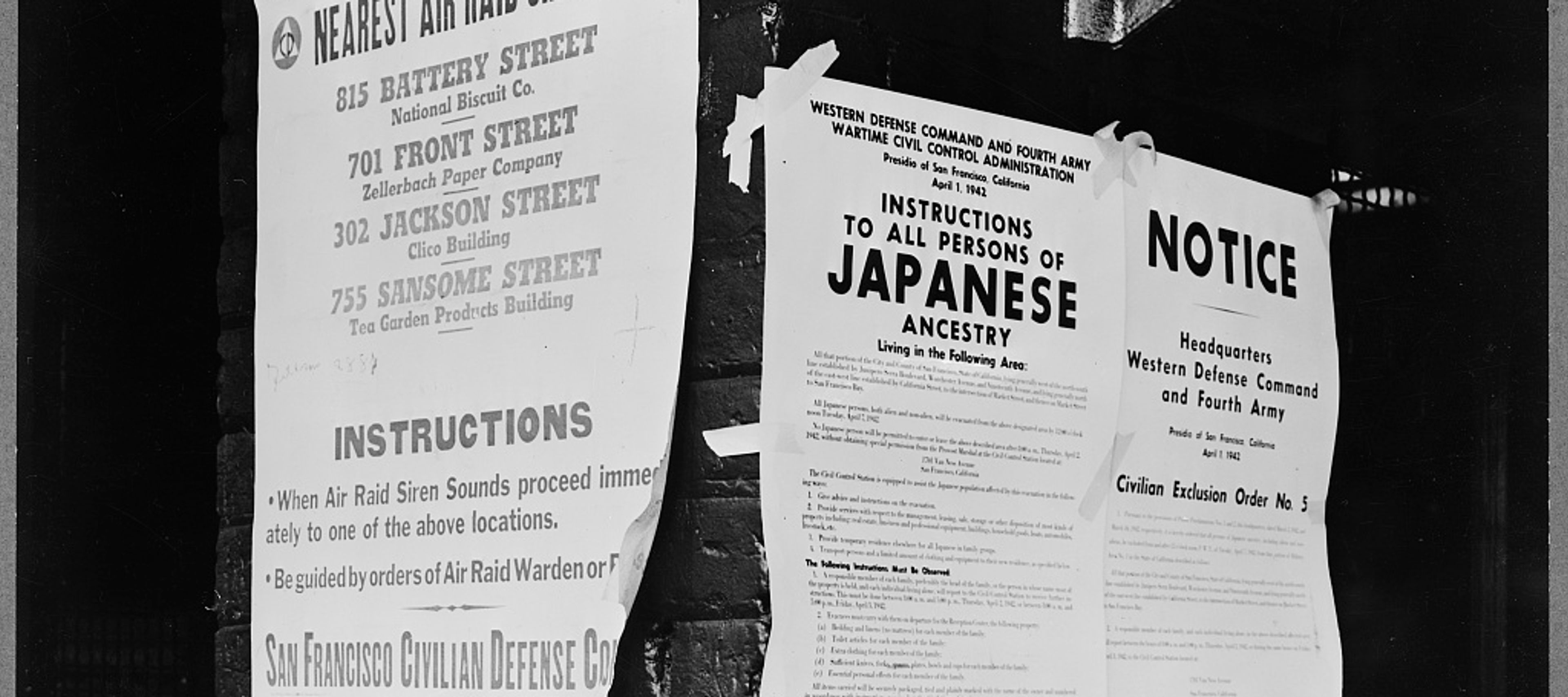
Around three months after the attack on Pearl Harbor, President Franklin D. Roosevelt signed Executive Order 1066 on February 19, 1942. The order authorized the U.S. military to forcibly remove all persons “deemed a threat to national security” to "relocation centers" further inland. Approximately 120,000 Japanese Americans across California, Oregon, and Washington were forced to leave their homes, businesses, and farms, only bringing what they could fit in their suitcases. While the relocation centers were being built, Japanese families were moved to “assembly centers” - quickly erected camps built on race tracks and livestock stables. After spending months in fields filled with manure and other animal products, Japanese Americans were sent via train to one of 10 relocation camps in Arizona, California, Arkansas, Idaho, Utah, Wyoming, and Colorado. Many families spent as much as three years at these sites.
While termed “camps,” first hand accounts reveal the relocation centers looked much more like prisons. Families were forced to live in very small quarters with little to no privacy, and the sites were surrounded by barbed wire and guard towers. People at the camps were warned of being shot if they approached the barbed wire fences. However, while structured as prisons, those interred were given a fair amount of freedom within the camps. Soon, each camp was administered by the Japanese community who resided within them. Farms and schools were developed, and athletics and the arts flourished, from American-style football games and swing dance nights to Japanese kabuki performances and calligraphy classes.
Additionally, younger people had some ability to leave the camps, either by volunteering to be laborers or working at religious organizations. As no Japanese were eligible for the draft, many enlisted - most joining the all-Japanese 442nd Regimental Combat Team, one of the most decorated regiments in the history of the U.S. military.
By 1946, most of the camps were evacuated, but the effects of this moment in history remain. Many Japanese Americans, having lost everything in the process of internment, restarted their lives close to the camp, resulting in a great disbursement of Japanese Americans across the country. Additionally, exposure to Japanese performing arts and culture within the camps led many nisei - or second generation Japanese - a greater appreciation of Japanese culture.
Today, artists such as Kishi Bashi use music as a way to remember this period, and, seeing parallels between the treatment of immigrants today with their treatment in the 1940s, serve to warn us of how quickly a citizen’s constitutional rights are revoked in moments of hysteria.
Disclaimers
Note on Terminology: In alignment with National and State Standards, this lesson uses the term "Japanese internment" to refer to this moment in history. TeachRock recognizes that the experiences faced by Japanese Americans at this time is better defined by the term "incarceration" and that the the term "Japanese," whenever present, would be more accurately defined as "Japanese American." For more, see https://densho.org/terminology/.
This lesson contains primary source documents and other materials that may include terms and images reflecting the attitudes, perspectives, and beliefs of different times that today are considered offensive and demeaning. TeachRock does not endorse the views expressed in these documents, but recognizes the value such materials provide for historical inquiry. For guidance on introducing controversial historical materials into the classroom, we suggest reviewing this document from the Library of Congress.
Preparation
- Display images from Gallery Walk - Life and Recreation at Manzanar War Relocation Center around the classroom, or be prepared to distribute the Gallery Walk electronically.
Connected Themes
Artist(s)
Genre(s)
Topics
Decade/Era
Monthly Theme