
190 mins
Late Reconstruction featuring The Jubilee Singers
Who were the Fisk Jubilee Singers and how do their experiences reflect the final years of Reconstruction in the United States?
Essential Question
Who were the Fisk Jubilee Singers and how do their experiences reflect the final years of Reconstruction in the United States?
Objectives
Know (knowledge):
- How division in the Republican Party and the rise of Democratic power in Congress contributed to the end of Reconstruction
- The Black Codes and violence in the South that reversed progress made during the early years of Reconstruction
- Other factors that led to the end of Reconstruction, including an economic depression and waning enthusiasm for the rights of freedmen
- The effort to disenfranchise newly freedmen, poor whites, and workers
- The Compromise of 1877 and its role in bringing Reconstruction efforts to an end
- The work of W.E.B Dubois, Black Reconstruction
Mastery Objective
- Students will be able to identify the reasons that Reconstruction came to an end and its lasting impact on the United States through the analysis of primary and secondary sources.
Background
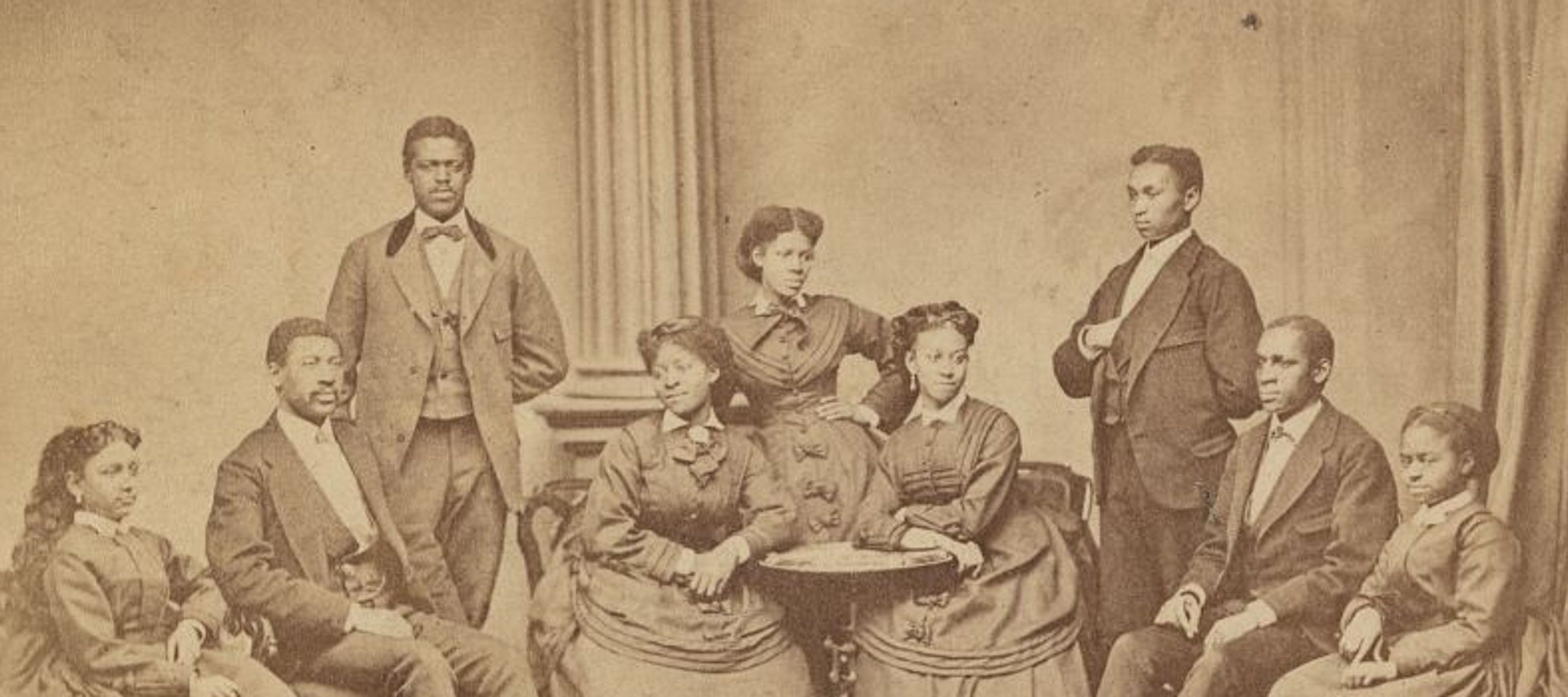
In this lesson, students will examine the tour of the Fisk Jubilee Singers, an a cappella group started at Fisk University in 1871 to raise money for the school. Students will analyze primary and secondary sources about the tour to determine why Reconstruction ended.
Fisk University (formerly the Fisk Free Colored School) opened in Nashville, Tennessee in 1866 to educate newly freed enslaved African Americans of all ages following the U.S. Civil War. In 1871, the school treasurer started the Fisk Jubilee Singers, an a cappella group, to raise money for the school that was struggling to stay open. The Fisk Jubilee Singers would travel widely around the United States and Europe where they introduced “slave songs” and were “instrumental in perserving this unique American musical tradition known today as Negro spirituals”. The Jubilee Singers are still a part of Fisk University today and celebrated their 150th anniversary on October 6, 2021.
The five years after the Civil War saw great progress for freedmen in the South as they used the legislation that gave them freedom to become the architects of their future. By 1872, 1,510 African Americans held offices ranging from local and state positions to multiple seats in the United States Congress. Across the South, African American delegates worked alongside poor whites to create truly “by the people” state constitutions that reflected social and economic equality. They worked to obtain public education for all, fair wages, property rights, and the right to vote. Successes of the state conventions included the first tax-supported public schools and legislation in South Carolina to aid poor farmers and tax large plantation owners. In addition to holding political offices, African Americans were the majority of registered voters in many Southern states.
By the middle of the 1870s this progress would be hindered or reversed entirely by several factors which lead to the end of Reconstruction in 1877. One factor that led to the end of Reconstruction was the division in the Republican Party that began around the Fourth Enforcement Act (or the Ku Klux Klan Act of 1871). All party members agreed that the violence against African Americans in the South was concerning, but they disagreed on how the federal government should respond. The more radical members thought that President Grant should be temporarily given more power to stop the violence in the South, including suspending the writ of habeas corpus. The more moderate members felt that this would expand the powers of the presidency too far and would be unconstitutional. They also feared that the Democrats would use this new federal power as a campaign point in the 1872 elections. Some moderate Republicans also believed that federal intervention would not fix the issues in the South, it was time to let the Southern people be responsible for finding solutions. While the Fourth Enforcement Act did pass, the conversations and divisions of the debate in Congress would continue for the next several sessions and no significant or impactful legislation would be passed for the civil rights of freedmen.
Another factor that led to the end of Reconstruction was the resurgence of the Democratic Party beginning in 1872. In 1872, Congress passed amnesty legislation that would let ex-Confederates hold public office which they were barred from by the 14th Amendment. After the economic Panic of 1873 and several scandals in the Republican party, the Democrats were able to gain significant power by winning Congressional seats in the 1874 election (Republicans lost 93 seats in the House and 9 in the Senate). The Democrats would control the House in the 44th Congress starting in 1875, making any further policy change for civil rights almost impossible.
The villainization of African Americans in the South and poor workers in the North was also a strategy Democrats used to disenfranchise both groups while bringing Northern Republicans to their side. Democrats portrayed both groups as bringing socialism to the United States and newspapers portrayed Southern governments as corrupt, siphoning money from the wealth of white taxpayers to poor ex-slaves. In 1875, the Supreme Court case Minor v. Happersett ruled that citizenship did not necessarily guarantee voting rights. This would provide the opportunity to disenfranchise people with other qualifications other than race, like property ownership.
By the Presidential Election of 1876, the momentum to continue Reconstruction policy was waning both in the political and public sphere. The disputed election of 1876 and the compromise that followed reflects the waning momentum and the culmination of political shifts in the early 1870s. The election between Rutherford B. Hayes (Republican) and Samuel J. Tilden (Democrat) came down to the disputed states of Florida, Louisiana, and South Carolina, all states in the former Confederacy. Through official and unofficial dealings in Congress, a compromise was developed. As part of the compromise, Congressional Democrats agreed to declare Hayes the victor of the presidential election if Congressional Republicans agreed to withdraw the last federal troops supporting governments in Louisiana and South Carolina. Republicans also agreed that they would no longer interfere in the affairs of states in the former Confederacy and leave home-rule of the South to Democrats. The Compromise of 1877 would signify the end of Reconstruction and Southern states would start to pass Jim Crow laws disenfranchising African Americans and implementing segregation.
Disclaimers
This lesson contains primary source documents and other materials that may include terms and images reflecting the attitudes, perspectives, and beliefs of different times that today are considered offensive and demeaning. Teachrock.org does not endorse the views expressed in these documents, but recognizes the value such materials provide for historical inquiry. For guidance on introducing controversial historical materials into the classroom, we suggest reviewing this document from The Library of Congress.
Materials
- A device with access to the internet for each student.
Preparation
- Display Gallery Walk - Jubilee Singers Tour Stops around the room.
- On a whiteboard or a big sheet of paper, create a space titled “Fisk University and Jubilee Singers Quick Facts”.
Connected Themes
Artist(s)
Genre(s)
Decade/Era