
90 mins
The Indigenous Roots of Rock and Roll
What does Link Wray’s biography say about how Native Americans lived in the first half of the 20th century, and what role did Wray’s upbringing have on his music?
Essential Question
What does Link Wray’s biography say about how Native Americans lived in the first half of the 20th century, and what role did Wray’s upbringing have on his music?
Objectives
Know (knowledge):
- How racism affected Native Americans in the mid 20th century
- A basic history of the Shawnee tribe
- About Shawnee-U.S. Government interactions under Presidents Jefferson and Jackson
- About the Shawnee role in the War of 1812
- About The Indian Removal Act and the Trail of Tears
- How segregating communities resulted in tight family units and the transmission of culture among different minority communities
- The effects wars can have on American veterans
- Connections between poverty and health in the United States
- The role faith and religion played in Link Wray’s development
- The extent to which a musician’s personal life might influence their music
- Connections between Link Wray’s “Rumble” to the poem Nationhood by Laura Da’
Mastery Objective:
- By examining videos and autobiographical accounts of Link Wray’s early life students will be able to imagine what life for a Shawnee person might have been like in the first half of the 20th Century, and how such an experience might have impacted Wray’s music.
Background
In this lesson, students watch clips from RUMBLE: The Indians Who Rocked The World and explore Link Wray’s position as an influence on later Hard Rock and Heavy Metal musicians. Students will investigate the history of the Shawnee Tribe, and use Wray as a case study to consider what life might have been like for a Shawnee in the American South during the early 20th Century. Finally, students debate ways Wray’s early life might have contributed to his future musical achievements, and find common themes between the song "Rumble" and the poem Nationhood by Laura 'Da.
Many would argue that Rock and Roll has historically been the music of rule breakers. It turns out that Rock and Roll is also the music of guitar amp breakers. Beginning in 1953 with guitarist Willie Kizart’s crackling part on Jackie Brenston and his Delta Cats’ “Rocket 88,” which was performed on a “broken” guitar amp, many guitarists in the emerging genre of Rock and Roll sought to overdrive and distort their sound. The Rolling Stones’ Keith Richards used a hi-tech new “fuzzbox” to achieve the menacing distortion heard on the 1965 hit “(I Can’t Get No) Satisfaction.” And, like many young guitarists did at the time, The Kinks’ Dave Davies slit the speaker cones on his amp to get the fuzzy tone of the 1964 hit, “You Really Got Me.” However, it likely wasn’t another British rocker, or even Kizart that Richards and Davies were emulating. It was Link Wray, a Native American from rural North Carolina.
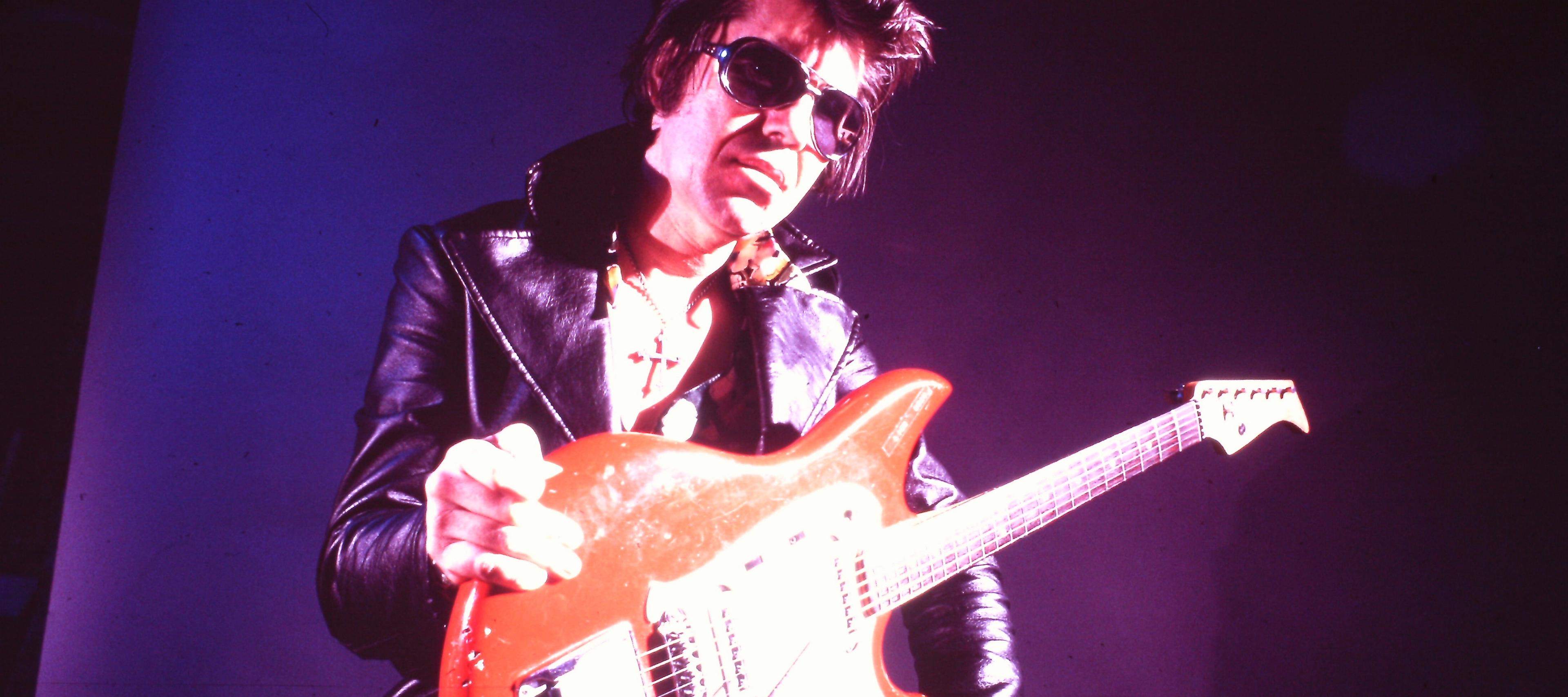
In January 1958, brothers Link, Doug, and Vernon Wray were performing as the house band in Fredericksburg, Virginia for a record hop organized by local DJ and TV personality Milt Grant. Shortly into the show, audience members requested the band play “The Stroll,” a song released a month earlier by The Diamonds. Link, the group’s guitar player, had spent much of the previous year in the hospital recovering from tuberculosis, and didn’t know “The Stroll.” Doug, the drummer, counted the song off anyway. Link had no choice but to play something. That something, which they named “Rumble,” was mostly three chords and a riff, sustained above Doug Wray’s lumbering 12/8 beat by the crunchy tone of Link Wray’s deliberately slashed speakers.
“It changed everything,” says Robbie Robertson in the film Rumble: The Indians who Rocked the World, “‘Rumble’ made an indelible mark on the whole evolution of where Rock and Roll was going to go.” Wray’s guitar part, simple to the ears of many, encapsulated the powerfully defiant attitude that would become a defining characteristic of future Rock subgenres such as Hard Rock, Punk, and Heavy Metal. Both Pete Townshend of The Who and Led Zeppelin’s Jimmy Page cite “Rumble” as a defining influence. Vocalist Iggy Pop remembers, “‘Rumble’ had the power to push me over the edge...it helped me say, ‘I’m going to be a musician.’” Pop wasn’t the only person who felt “Rumble,” an instrumental, might push one “over the edge.” Fearing that “Rumble” could inspire juvenile delinquency, it was banned by several radio stations, even in major cities such as Boston and New York. Though the song is over 60 years old, “Rumble” continues to evoke strong feelings in many, and it has been placed in films and TV Shows such as Pulp Fiction, Independence Day, and The Sopranos.
Some suggest the raw emotional power of “Rumble” is a musical reflection on the Wrays' tumultuous childhoods. The Wray brothers were born in Dunn, North Carolina, to a Shawnee mother. “While Elvis grew up white-man poor,” Link often said, comparing himself to one of his idols, “I grew up Shawnee poor.” His mother was crippled by racist violence she experienced as a child, his father shellshocked by his experience as a soldier World War I. As a child, Link sometimes hid with his brothers under their beds as the Ku Klux Klan terrorized their segregated neighborhood. But at the same time, Link’s childhood in Dunn positively contributed to his musical development. His mother, a street preacher, instilled in him a love of song, and a local blues musician known as Hambone gave him his first guitar lessons. As filmmaker Antonino D’Ambrosio suggests in RUMBLE, these musical influences might have allowed Wray to take his difficult past and translate it in proactive ways.
Connected Themes
Artist(s)
Monthly Theme