
90 mins
Musical Ratios
What role do ratios play in the Western musical concepts of rhythm and harmony?
Essential Question
What role do ratios play in the Western musical concepts of rhythm and harmony?
Objectives
Know (knowledge):
- Ratios are used to make comparisons between two things
- How to find equivalent ratios using proportions
- The definition of “rhythm,” “interval,” and “harmony” in Western music theory, and how these components of music are derived from ratios
- The ways the ratios between two pitches determine their sonic characteristics
- The mathematics behind the Pythagorean 7-note scale
Mastery Objective:
- Students will be able to simplify ratios and find equivalent ratios using proportion by investigating rhythm in Western music, recreating the pythagorean scale, and calculating the C scale tuning ratios.
Background
In this lesson, students simplify ratios and find equivalent ratios using proportions as they investigate rhythm and harmony in Western music, recreate the 7-note Pythagorean scale, and calculate ratios between musical intervals.
Musicians and composers could be thought of as chefs. They gather a collection of sonic ingredients - whether from instruments, electronics, or nature - and mix them to create something new and unique. And just like cooking, the creation of music is greatly aided by shared concepts and standardized measurements.
Such musical conceptions and measurements vary across the globe, depending upon the culture and history of the given region. The system often used for Western classical and popular music has developed over hundreds of years, starting when the Holy Roman Emperor Charlemagne initiated a project of writing and standardizing notation for religious chants.
Two of the primary components of the Western musical system are rhythm and harmony. Rhythm defines how often sounds are played in a given period of time. Harmony speaks to the relationships between the pitches or frequencies of the notes played.
Both rhythm and harmony are based on mathematical ratios.
For rhythm, these ratios are derived rather simply: they are based on the number of notes or sounds played in relation to the beat, or underlying pulse, of a piece of music. For instance, one note could be played in the span of four, three, two, or one beat(s). Conversely, one to eight or more notes could be evenly played in the span of a single beat. Often in music, multiple rhythms occur simultaneously, and the ratios between these contrasting rhythms often inform how complex a piece of music sounds.
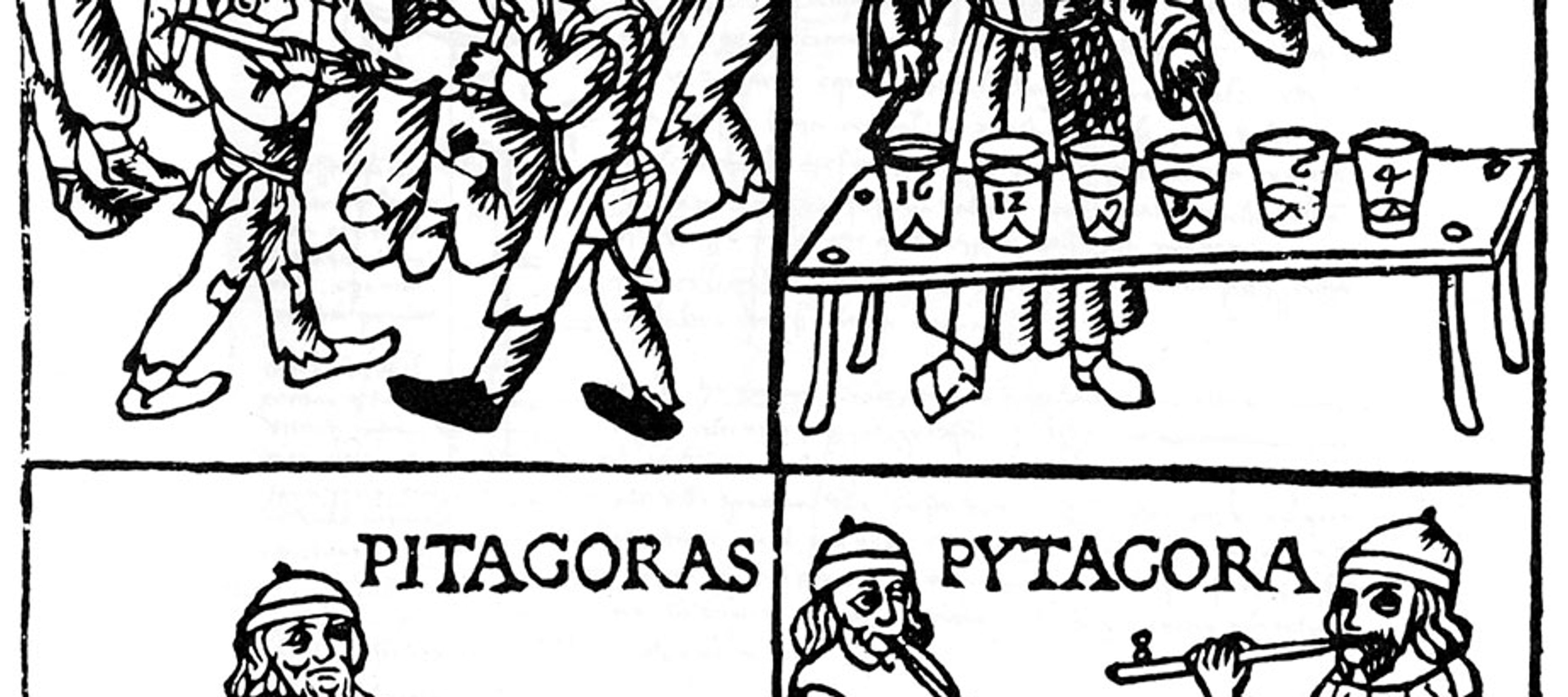
The use of ratios in Western music harmony is more complex, going at least as far back as Pythagoras’ experiments with a monochord, a single stringed instrument, in the 6th century B.C.E. In his experiments, Pythagoras discovered that plucking a string at certain ratios to its total length created sounds he considered pleasant. From these experiments, he derived a collection of seven notes for creating music. These notes were not based upon specific frequencies, but rather derived from specific ratios in relation to a root pitch. In other words, it was the ratios between the notes that created the Pythagorean tuning system - it was only much later that the notes in the Western musical system were set to specific frequencies, and expanded into twelve total notes. Even today, Pythagoras’ seven-note based system is regularly used, and referred to as a scale.