
90 mins
Musical Reactions to the Vietnam War
How were American’s divisive opinions over the Vietnam War articulated by musicians in the 1960s and early 1970s?
Essential Question
How were American’s divisive opinions over the Vietnam War articulated by musicians in the 1960s and early 1970s?
Objectives
Know (knowledge):
- Seminal events during the Vietnam War, including the Gulf of Tonkin Resolution, The Tet Offensive, the My Lai Massacre, the election of Richard Nixon, and the Kent State shootings
- The feelings Americans had about the Vietnam War, including the division between the “Doves” and “Hawks”
- The way popular music either directly contributed to discussions about the Vietnam War, or was appropriated by pro- and anti-Vietnam War groups
Mastery Objective:
- Students will be able to define the differing political viewpoints Americans had during the Vietnam War by examining the music, journalism, and photography of the era.
Background
In the years following World War II, a brief period of American euphoria gave way to fear of a new antagonist: communism. Though the U.S. and the Soviet Union were allies during the war, Soviet efforts to rebuild Eastern Europe in its own image led to an American fear of ever-spreading communism and caused a rift between the two countries. Allies no longer, the U.S. and the Soviet Union engaged in an indirect conflict known as the Cold War from 1947 until the communist government collapsed in 1991.
Regardless of tensions, the United States and the Soviet Union, now the world’s two nuclear superpowers, knew that a direct war would lead to “mutually assured destruction” in which both countries would lose. Therefore, each nation sought to pursue its aims “by proxy” in other nations. In 1956, with the aid of the Soviets, the League for the Independence of Vietnam overthrew the U.S.-supported French colonial government in Vietnam, leaving the country divided into a Soviet-backed communist North and U.S.-backed republic South. Fighting erupted between the two sides in the early 1960s.
What began as an envoy of U.S. “advisors” to South Vietnam in 1964 quickly escalated, and by 1969, 500,000 U.S. troops were involved in the conflict. As the American body count rose--nearly 17,000 U.S. soldiers died in 1968 alone--Americans became divided on the war’s merit. The pro-war “Hawks” feared loss in Vietnam would signal a victory for the Soviet Union, and that protecting the United States from the perceived “communist threat,” wherever it might appear, was one’s patriotic duty. The anti-war “Doves” felt the war was barbaric, and the casualties on both sides served little to no purpose. In 1970, division over the Vietnam War reached a point of crises: in May that year, the National Guard shot and killed four anti-war student protesters at Kent State University.
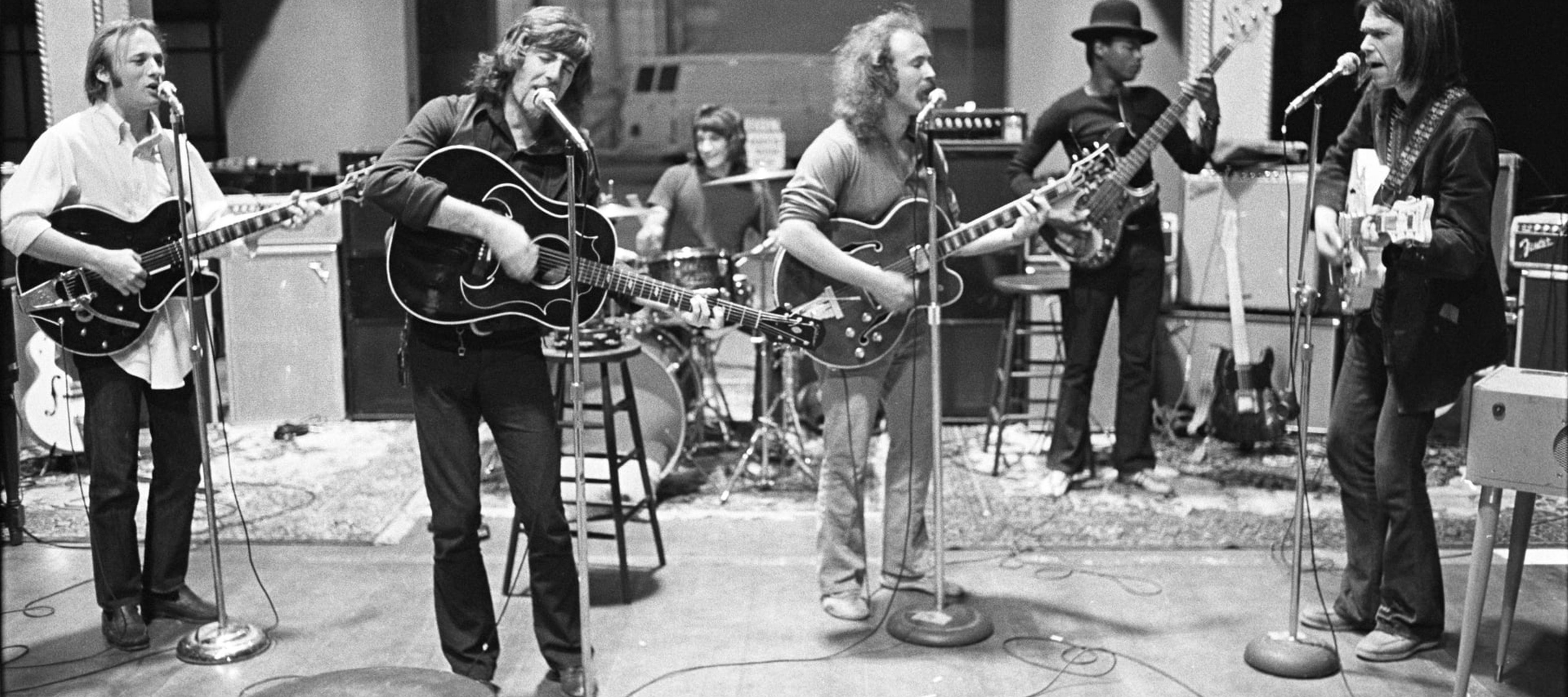
Today, the tragedy at Kent State might not be best remembered through a news article, but a song: Crosby, Stills, Nash, and Young’s “Ohio,” which powerfully articulates the moment when the violence of the Vietnam War was turned inward, upon American students. But “Ohio,” was one of many songs in the 1960s and 1970s that signified the cultural division between the Hawks and Doves.
In this lesson, students examine how Crosby, Stills, Nash, and Young’s “Ohio,” Merle Haggard’s “Okie From Muskogee” and Edwin Starr’s “War” articulated the divisive feelings Americans had about the war in the late 1960s and early 1970s. To supplement these songs, students will also watch clips from CNN Soundtracks and analyze polling data, news articles, and photographs from the era.
Connected Themes
Topics
Decade/Era
Monthly Theme