
90 mins
Native Americans and Westward Expansion featuring Redbone
What were the experiences of Native Americans during Westward Expansion and how did the U.S. government use music and other aspects of culture to force assimilation on Native Americans?
Essential Question
What were the experiences of Native Americans during Westward Expansion and how did the U.S. government use music and other aspects of culture to force assimilation on Native Americans?
Objectives
Know (knowledge):
- The history of the Wounded Knee Massacre
- Native American reservations in terms of the The Dawes Act and Treaty of Fort Laramie
- The U.S. Government’s Federal Indian Boarding School policies to force assimilation
- The movement to “civilize” Native Americans during this period by attempting to control music and other aspects of culture
- The Dakota Access Pipeline and the Standing Rock Indian Reservation in 2016
Mastery Objective
- Students will be able to describe the Native American experience during Westward Expansion through the analysis of media and primary sources.
Background
In this lesson, students are introduced to Pat Vegas and Redbone by way of interviews and music from the documentary film, RUMBLE: The Indians Who Rocked the World. They then look back to the late 19th century to consider the significance of Redbone’s success in the 1970s. Students will use clips from RUMBLE, as well as a set of source documents to assess the U.S. Government’s attempt to control Native American populations by way of culture, particularly music. Students will also examine the relationship between the U.S Government and Native Americans in terms of reservations and treaties. Lastly, students will connect the past with the present when they analyze information about the Dakota Access Pipeline and the Standing Rock Indian Reservation from 2016, comparing it to events from the lesson.
As settlers moved West in the last part of the 19th century, the Federal Government came into conflict with Native American tribes living on their homelands. During this time period, the government implemented a policy of forced assimilation in an attempt to control Native American populations. The implementation of the policy included banning traditional music, enrolling Native children in the Federal Indian Boarding Schools system, and controlling land allotments under the Dawes Act. Above all, these actions sought to erase various aspects of Native American culture and tradition. The Federal Government also developed the reservation system to resettle Native American tribes, promising through treaty agreements that reservation land would belong to Native Americans and their communities would be provided resources. The reality was that Native American reservations did not get the resources promised and the U.S. Government violated treaty agreements. For example, when gold was discovered in the Black Hills of the Great Sioux Reservation in 1874, the U.S. Government displaced Native Americans in violation of their treaty agreement.
To a present-day listener with no additional context, Redbone’s single “Come and Get Your Love” may just sound like a classic mid-’70s Rock tune. The song, which many might recognize from the opening sequence of the 2014 film Guardians of the Galaxy, consists of sparse lyrics repeated over a loose funky groove - not necessarily a song with a message or a “deep” meaning. However, “Come and Get Your Love” is in many ways a breakthrough track. It peaked at No. 5 on the Billboard Hot 100 singles chart in 1974, and achieved “Gold” status, meaning it sold at least half a million copies in the United States. This marked the first time an outwardly Native American ensemble had reached such popular culture heights in America.
Pat and Lolly Vegas, the Yaqui, Shoshone, and Mexican American brothers who founded Redbone in 1969, hadn’t always been “outwardly” Native American in performance. In the early 1960s, the brothers began their professional careers playing “Surf” music in Los Angeles. They recognized that their family surname, “Vasquez,” would mark them as Mexican American and limit their potential. So, the Vegas brothers were born. However, as national attitudes toward identity and ethnicity began to evolve later in the decade, the Vegas brothers decided to take the advice of part-Cherokee friend Jimi Hendrix and, as Pat Vegas puts it, “do the Indian thing.” Redbone performed in Native American clothing, and also worked traditional drum, dance, and song into performances, even on TV.
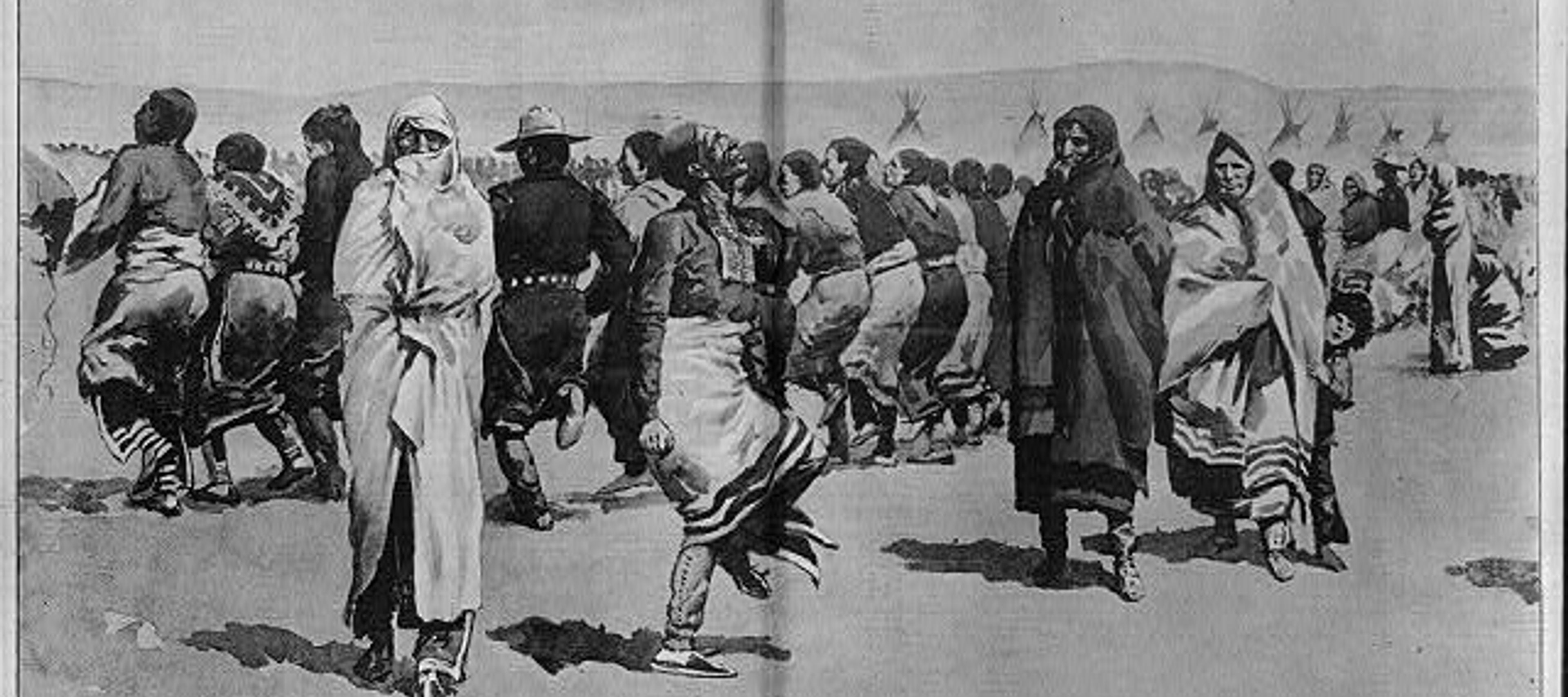
Redbone’s success came less than a century after the U.S. Government banned traditional expressions of Native American song and dance. Notably, the group’s musical triumph occurred 84 years after the Wounded Knee Massacre. The Wounded Knee Massacre is considered by many to be the deadliest mass shooting in modern U.S. history. On December 29, 1890, the U.S. Army murdered nearly three-hundred Lakota men, women, and children, ostensibly because they refused to cease performing a pan-tribal ritual known as the “Ghost Dance.”
Disclaimers
This lesson contains primary source documents and other materials that may include terms and images reflecting the attitudes, perspectives, and beliefs of different times that today are considered offensive and demeaning. Teachrock.org does not endorse the views expressed in these documents, but recognizes the value such materials provide for historical inquiry. For guidance on introducing controversial historical materials into the classroom, we suggest reviewing this document from The Library of Congress: https://blogs.loc.gov/teachers/2011/11/dealing-with-difficult-subjects-in-primary-sources.
Materials
- Four large sheets of paper
Preparation
- Create four stations around the room using the following handouts from the Rumble lesson collection and the four large sheets of paper (one handout and one large sheet of paper at each station).
- Write or print the Document Based Question below at the top of each large sheet of paper:
- In what ways did the U.S. Government attempt to control Native Americans in the late 19th Century as the West was settled?