
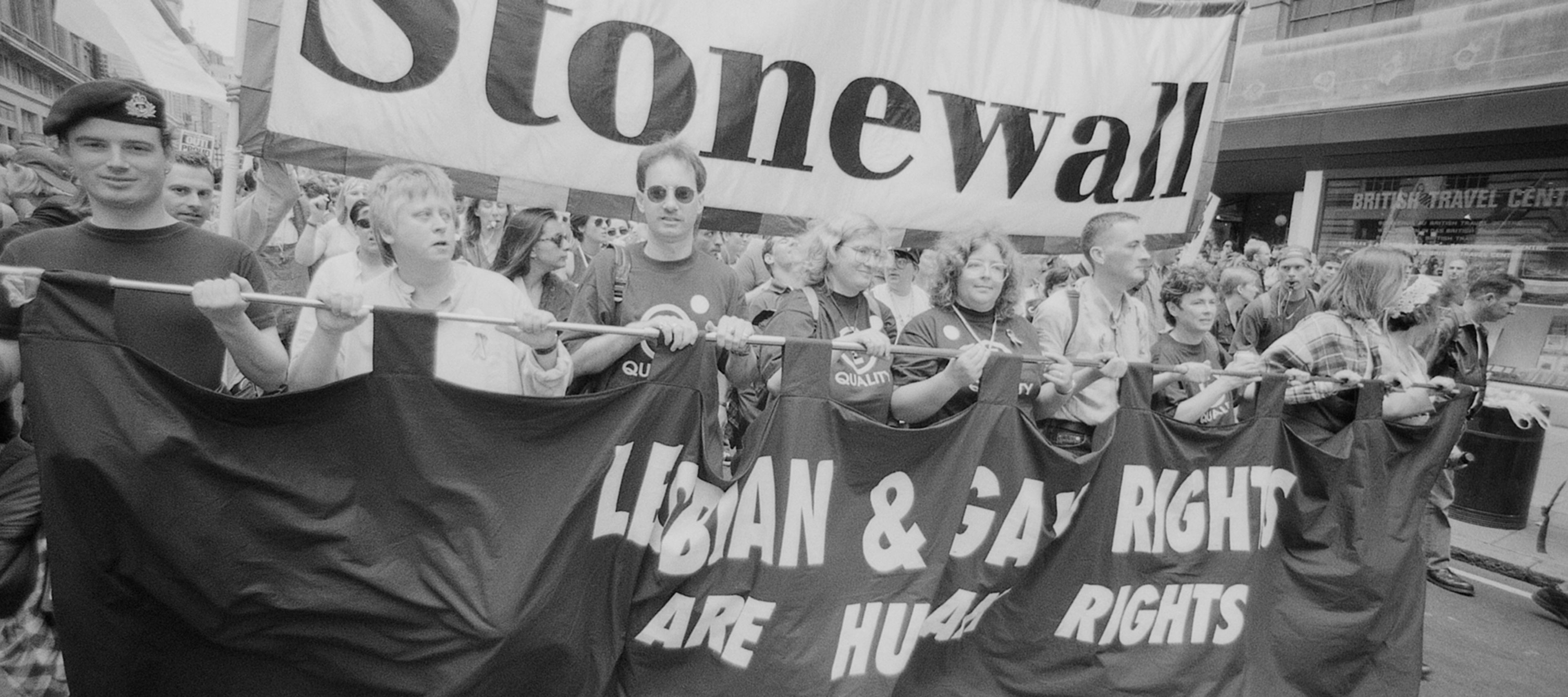
“Seneca Falls, Selma, Stonewall”: The Stonewall Riots in the Fight for Equality
What were the Stonewall Riots, and what role did they play in ongoing struggles for LGBTQ+ equality in the United States?
Essential Question
What were the Stonewall Riots, and what role did they play in ongoing struggles for LGBTQ+ equality in the United States?
Objectives
Know (knowledge):
- The historical significance of the Stonewall Inn
- The circumstances that led to the Stonewall Riots, and their lasting effects
- Rod Stewart’s “The Killing of Georgie” as a testament to LGBTQ+ discrimination
- The possible connection between the Stonewall Riots and the Women’s Rights and Civil Rights Movements
- The historic importance of the Seneca Falls Conference and the Selma to Montgomery March
Mastery Objective:
- Students will be able to determine the significance of the Stonewall Riots to the history of social justice movements in the United States by analyzing visual sources, reading primary documents, and examining popular music.
Background
We, the people, declare today that the most evident of truths--that all of us are created equal--is the star that guides us still; just as it guided our forebears through Seneca Falls, and Selma, and Stonewall; just as it guided all those men and women, sung and unsung, who left footprints along this great Mall, to hear a preacher say that we cannot walk alone; to hear a King proclaim that our individual freedom is inextricably bound to the freedom of every soul on Earth.
President Barack Obama’s soaring words echoed through the National Mall on Inauguration Day in 2013. For his second inaugural address, he joined together text from the nation’s founding documents with sociopolitical movements that reflected the country’s progress since its inception. At Seneca Falls in 1848, the Women’s Rights Movement was launched with the creation of the Declaration of Sentiments, which demanded equality between the genders. In Selma in 1965, Dr. Martin Luther King, Jr. galvanized citizens across the country in the demand for equal voting rights for African Americans. And in Stonewall, a police raid on a local gathering place initiated the modern Gay Rights movement.
President Obama’s speech was especially important for the LGBTQ+ community, for in that moment, the highest elected official in the country recognized the history of discrimination that confronted LGBTQ+ people--a history that was none too far in the past. Until 1973, homosexuality was considered a psychiatric disorder by the American Psychiatric Association. Since World War II, the federal government consistently sought to deny LGBTQ+ people representation: in 1942, the government began screening military recruits in order to exclude gay men; in 1944, recruits for the Women’s Army Core were additionally screened; and by 1953, homosexuals were banned from being employed by the federal government. To this day, courtrooms across the country still allow what is termed the Gay and Trans “Panic” defense, a tactic which uses the victim’s gender identity or sexual orientation to partially or even fully excuse the violent actions of the perpetrator.
In such an environment, coming out as an LGBTQ+ person has carried the threat of familial or social alienation, potential unemployment, damaging shock or “conversion” therapy, and being abused or killed with impunity. For this reason, many flocked to urban centers that have had a reputation of being more accepting of LGBTQ+ people, such as New York City’s Greenwich Village neighborhood. But even here, people faced discrimination: in the 1950s and 60s, New York City regularly revoked liquor licenses for establishments with the reputation of serving LGBTQ+ people, and the police regularly raided establishments and arrested patrons under the charge of “unruly conduct.” Often, media accompanied such police raids, threatening to expose people who frequented the establishments. This drove LGBTQ+ people to dangerous, often illegal bars that bribed police officers to avoid raids--places such as the Stonewall Inn.
Opened in 1967, the Stonewall Inn was a Mafia-run bar and dancehall catering to LGBTQ+ people. In order to stay open, the owners bribed the police on a monthly basis, with money procured by selling overpriced drinks and, as some have accused, blackmailing wealthier patrons. Even still, police regularly harassed customers.
On June 28, 1969, four plainclothes policemen entered the Stonewall Inn, intent on shutting down the establishment, perhaps permanently. But, as Anti-war, Women’s Rights, and Civil Rights Movements subsumed the country, those inside Stonewall as well as pedestrians in the neighborhood were less willing to oblige the authorities. As patrons began to be handcuffed and loaded into police vans, a bystander shouted “Gay Power!” Soon, people were resisting arrest and bystanders began throwing coins and bottles at police vehicles. A riot ensued, and the police officers barricaded themselves within the bar, only to be freed when tactical police force units arrived. For the next two nights, the riots continued.
Like the Selma to Montgomery March and the Seneca Falls Convention, the Stonewall Riots spread national awareness of the discrimination faced by LGBTQ+ people. They also inspired many in the community to no longer be ashamed of their sexuality, but to stand up for their rights as equal American citizens. For this reason, it is widely considered the founding moment of the modern Gay Liberation Movement.
In this lesson, Barack Obama's second inaugural address serves as a launching point for classroom discussions on how the Stonewall Riots might be comparable to other seminal moments in the ongoing fight for equality in the United States. To supplement these discussions, students will analyze Rod Stewart's "The Killing of Georgie" as a poetic account of LGBTQ+ discrimination in the United States, and compare primary source documents from the Women's Rights, Civil Rights, and LGBTQ+ Rights movements.
Slides
Connected Themes
Artist(s)
Genre(s)
Decade/Era
Monthly Theme