
90 mins
Signature Style in Art and Album Covers
How have visual artists worked with musicians without compromising their style?
Essential Question
How have visual artists worked with musicians without compromising their style?
Objectives
Know (knowledge):
- Discover the work of visual artists Keith Haring and Mickalene Thomas
- Explore how artists establish their distinct styles with their work
- Examine how Haring's and Thomas’s work has been used for album covers by musicians Malcolm McLaren and Solange
Mastery Objective
- Students will be able to draw connections between music and visual arts by examining collaborations between Keith Haring and Malcolm McLaren, as well as Mickalene Thomas and Solange.
Background
In this lesson, students consider how the work of visual artists can complement the work of musicians. Students will first consider the role album covers play in giving added meaning to a musical artist’s work. They then investigate the collaboration between music producer Malcolm McLaren and visual artist Keith Haring, as well as the collaboration between visual artist Mickalene Thomas and musical artist Solange on her EP True. In their analysis, they consider the ways Haring’s and Thomas’s work on album covers relate to their other artistic work, as well as how Haring and Thomas’s contributions help supplement the music of Malcolm McLaren and Solange.
While music consumption has moved from the physical to digital realm, the visual aspects of a musician’s work remains as, if not more, important to an artist’s career, image, or persona. Album art remains as prolific as ever - its presentation has simply moved from the paper and cardboard of an album to a digital thumbnail displayed on a music streaming service. Music videos have expanded into complete visual albums, ready to be watched at any time with a click of a button. And performances, whether live or live-streamed, have only grown more spectacular, incorporating choreography, sets, costuming, even virtual reality.
This lesson encourages students to consider what the visual arts in particular bring to the publication of music by examining two visual artist’s collaborations with musicians.
Born in 1958 in Reading, Pennsylvania, Keith Haring became one of the most globally prominent artists in the 1980s. After graduating from the School of Visual Arts in New York City, he began creating art in subway stations, spray painting his outlined figures. Haring soon moved from subways to murals, and began mingling with Downtown New York socialites such as Andy Warhol, Madonna, and fellow street artists such as Jean-Michel Basquiat. As he grew more prolific, his work evolved, becoming more political and serving as social commentary as the AIDS and Crack epidemics came to head in the 1980s. Haring’s own AIDS diagnosis influenced his work and philanthropic efforts, and he became a member of ACT UP in the late 1980s. His life and career were cut short in 1990, when he passed away from AIDS complications. Several of his murals have been preserved and his work resides in the collections of major institutions.
It was likely Haring’s association with the New York City Art scene that caught the attention of impresario, manager, and music producer Malcolm McLaren, who collaborated with Haring for his 1983 Duck Rock, an album many critics believed brought the then-emerging art forms such as Djing, graffiti, and breakdancing to a wider public attention.
Mickalene Thomas is a contemporary artist whose work has appeared in various forms and in places that go beyond the expected museum gallery wall. Known for her vibrant use of collage to center and celebrate Black women, Thomas’s work has existed in mediums such as film, installations, public murals. She has also been featured in editorials, such as Cardi B’s 2018 W magazine cover and Time magazine’s March 2020 cover celebrating 100 years of influential women, in which Thomas was selected to honor trans rights activist Marsha P. Johnson. Thomas’s work has even appeared as a limited handbag, when she collaborated with French luxury brand Dior to re-envision their iconic Lady Dior bag in 2019.
Thomas’s influences are aplenty as they include French modernists, Édouard Manet and Henri Mattise, Harlem renaissance artists Jacob Lawrence and collagist Romare Bearden, and the notable photographer Carrie Mae Weems, who Mickalene Thomas has photographed for T magazine in 2018.
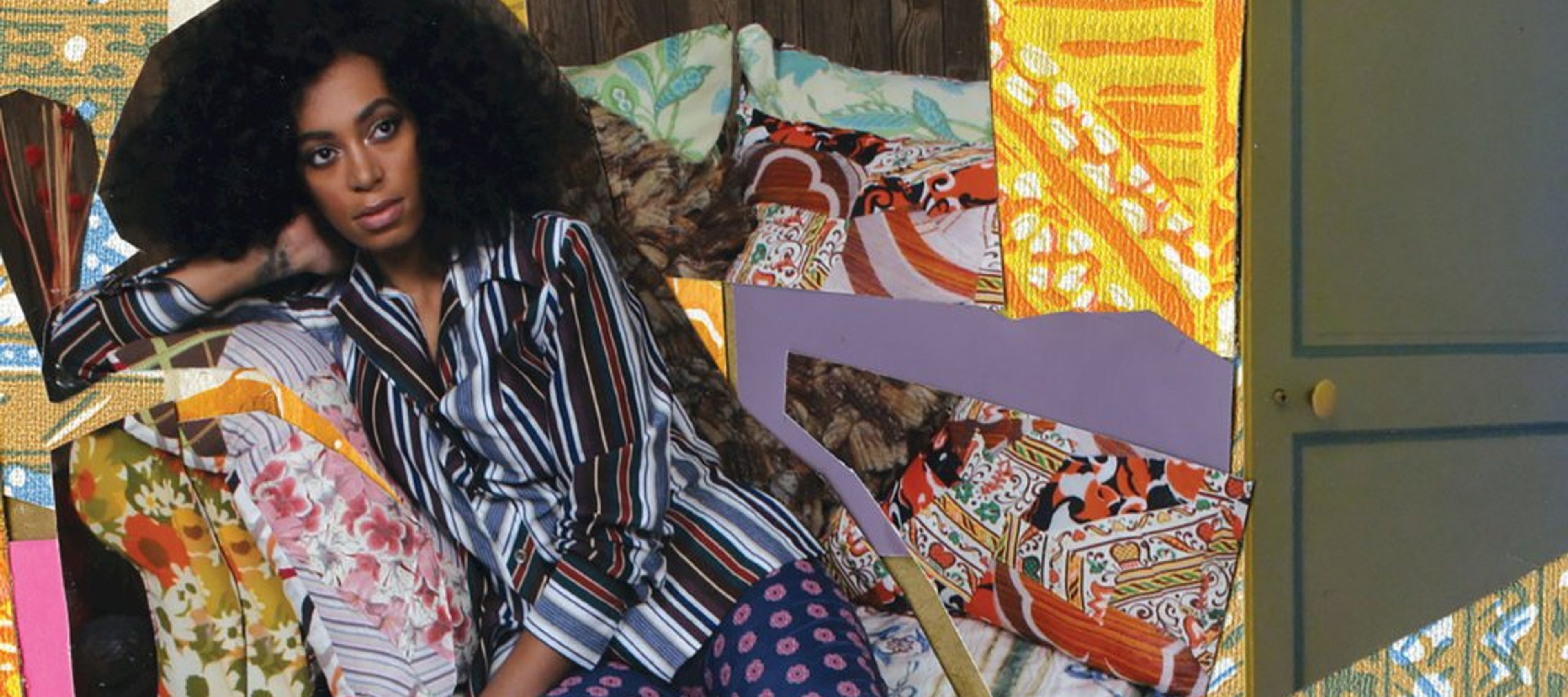
For her EP True, musical artists Solange commissioned Thomas for the cover. Thomas created a collage-like image that features the Solange, outfitted in a stripe blazer and blue and pink printed pants, laying on a multi patterned floral sofa amongst a collage of other bold patterns and objects.
Preparation
- Before class begins, print out Gallery Walk - Album Cover Images and place the images around the classroom. (Alternatively, teachers can project the document to the class as a slideshow.)