
90 mins
Singing Democracy During the Second Great Awakening
What was the Second Great Awakening, how did it change American society, and how does Sacred Harp singing exemplify its ideals?
Essential Question
What was the Second Great Awakening, how did it change American society, and how does Sacred Harp singing exemplify its ideals?
Objectives
Know (knowledge):
- The political and social landscape of Antebellum United States
- The causes and historic effects of the Second Great Awakening
- Sacred Harp Singing
- Prominent religious figures and social activists during the Second Great Awakening, including Lyman Beecher, Charles Finney, Richard Allen, Nat Turner, Theodore Weld, Lewis Tappan, Elizabeth Cady Stanton, and Angelina Grimké
Mastery Objective:
- Students will be able to recognize how the Second Great Awakening influenced American society and culture by analyzing footage of religious singing, and reading biographies of seminal figures in the movement.
Background
On September 3rd, 1783, Benjamin Franklin, John Adams, John Jay, and Henry Laurens met with British Representatives David Hartley and Richard Oswald in Paris’ Hotel d'York. Together they signed the Treaty of Paris, which officially recognized the United States as a sovereign country. After seven years of fighting, the Revolutionary War had been won, and Americans were free to craft a nation as they saw fit.
But as the metaphorical dust cleared, new challenges confronted the fledgling country. The economy and culture of the northern and southern states grew further apart, making unification a trying process. The powers granted to the federal and state governments had to be carefully balanced, and the interests of both urban and rural Americans needed to be negotiated. But perhaps most urgently, the so-called “Land of the Free” had to confront its own reliance on slavery.
While politicians negotiated the governmental foundations of the United States, religious leaders were worried about the moral and cultural future of the country. The Revolutionary War had levelled churches in many colonies, and people were also beginning to move west, where organized religion had little foothold. The separation of church and state had been ingrained into the Constitution, ensuring that religious denominations would receive no help from the State in building congregations. The religious leaders also worried that the Deism embraced by many of the Founding Fathers--the belief that God did not intervene with the world through miracles or revelations--was too human-centric and dismissed the more spiritual aspects of religious belief. Would America move forward without God?
In response to these concerns, preachers and ministers such as Charles Grandison Finney, Peter Cartwright, and James McGready attempted to reignite a religious fervor within the country by holding a series of revival “camp meetings” throughout America. Characterized by intense preaching, communal singing and heightened emotions, camp meetings quickly became a national sensation. The meetings were so successful at converting people, in fact, that the era between the Revolutionary and Civil War in the United States became known as “The Second Great Awakening,” the second time since the early 1700s that Americans embraced religion in large numbers.
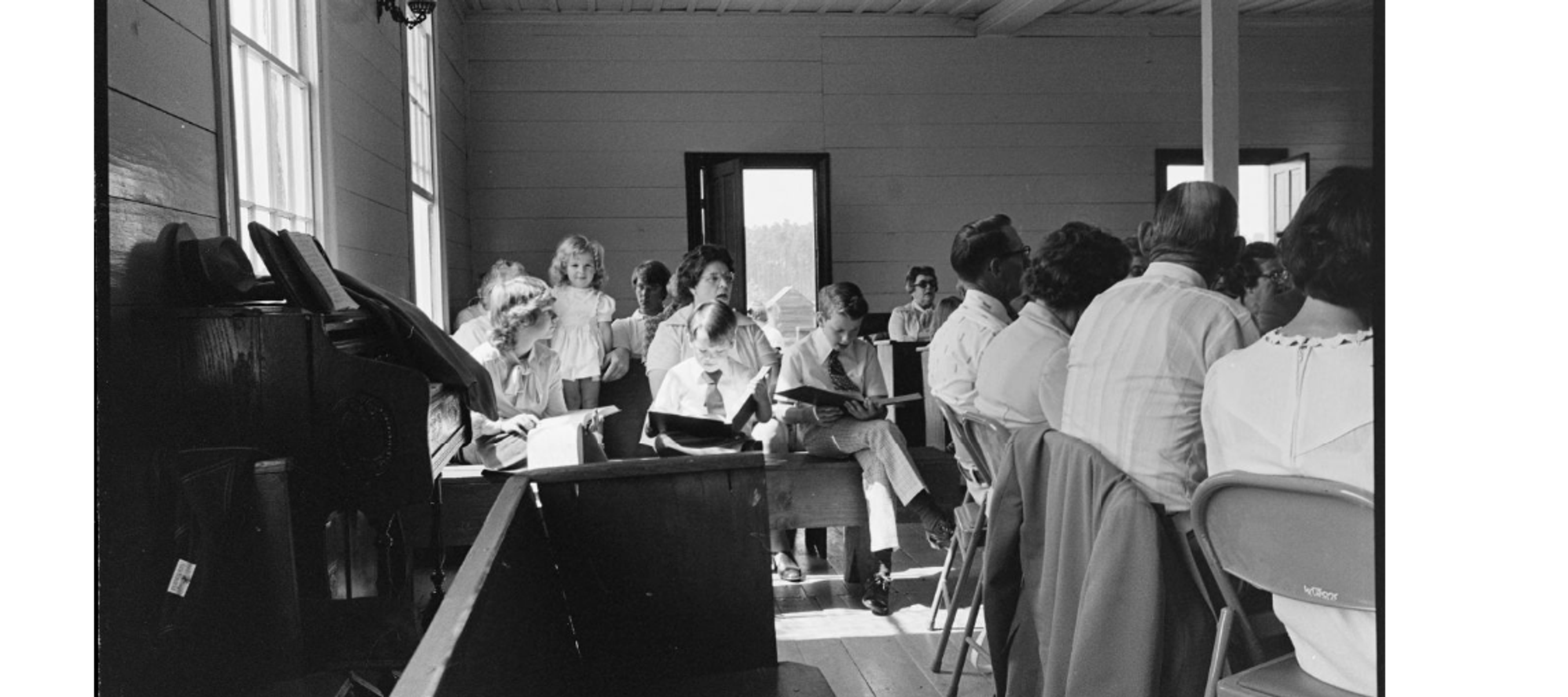
Music provided much of the time the energy and emotion that made camp meetings popular. Preaching was interspersed with collective hymn, and gospel singing which would spontaneously arise from the crowd. This singing was often repetitive and improvistary, and attendees would regularly add religious lyrics to popular melodies. Soon, the songs commonly sung during camp meetings were compiled into hymnbooks. Arguably the most famous of such books was The Sacred Harp, published by Benjamin Franklin White and Elisha J. King in 1844. Written using a shape-note system that made singing accessible to those without formal music training, the book was so popular that it become synonymous with a unique style of music. “Sacred Harp” singing continues to be performed to this day.
The Second Great Awakening significantly altered the course of American politics and society. Through the camp meetings, Americans gradually turned away from a Calvinist mode of religious thought that privileged fate and predestination to an Arminian theology that stressed free will and personal moral responsibility. This turn in religious outlook helped create a generation of social activists who played seminal roles in the temperance, abolition, and suffrage movements that would continue into the 20th century. Set upon bringing the Earth into a closer alignment with Heaven, activist such as Lyman Beecher, the Grimké Sisters, Theodore Weld, and the Tappan brothers fought for a complete and unequivocal equality between the races and sexes--demands that many are still working towards today.
In this lesson, created in partnership with the Association for Cultural Equity, students discover the causes, characteristics, and lasting effects of the Second Great Awakening by examining the biographies of historical figures associated within the movement. They also consider how Sacred Harp Singing represents the ideals of the Second Great Awakening by watching Alan Lomax’s ethnographic videos of a Sacred Harp performance.