
90 mins
The End of the Cold War featuring Billy Joel
What four factors led to the end of the Cold War?
Essential Question
What four factors led to the end of the Cold War?
Objectives
KNOW (KNOWLEDGE):
- How Billy Joel’s concert performances in the Soviet Union in the summer of 1987 exemplifies the gradual thawing of the Cold War
- The four factors that led to the end of the Cold War: economic, military, civil, and diplomatic
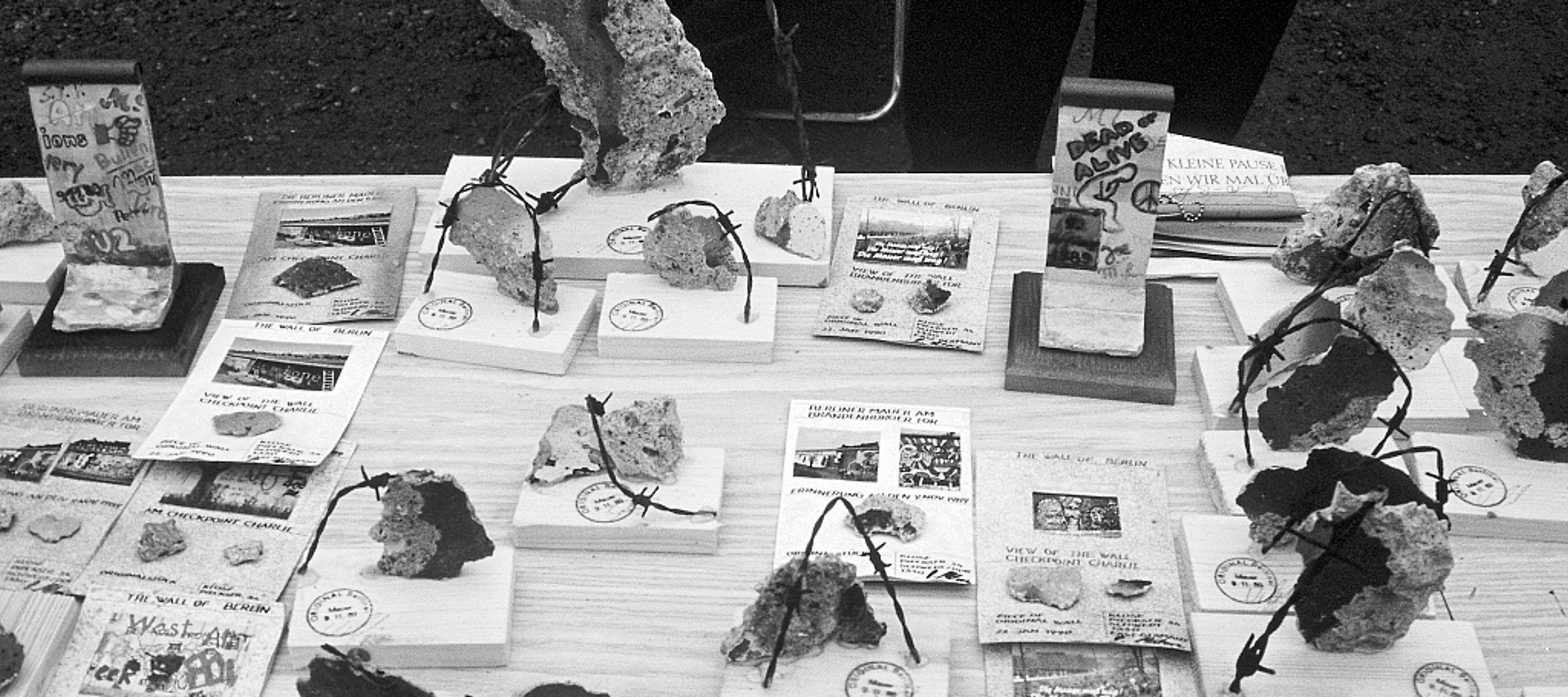
- The historical importance of the fall of the Berlin Wall
MASTERY OBJECTIVE:
- Students will be able to make connections between the economic, civil, military, and diplomatic factors that led to the end of the Cold War by creating a “case board” based on primary sources.
Background
“How did you go bankrupt?’ Bill asked. ‘Two ways,’ Mike said. ‘Gradually, then suddenly.”
- Ernest Hemmingway, The Sun Also Rises
In this lesson, students identify the four factors that led to dissolution of the U.S.S.R. and the end of the Cold War. By analyzing key economic, military, diplomatic, and civil events during the 1970s and 1980s through primary sources, students draw connections to see how the combination of various factors contributed to the end of the Cold War. They also examine how cultural events such as Billy Joel’s concerts in Russia in 1987 precipitated the eventual end of the U.S.S.R in 1991.
The end of the Cold War seemed to arrive suddenly in 1989. In August of that year, the Polish trade union Solidarność ushered in the first democratically elected government in Eastern Europe for 41 years. Three months later, the Berlin Wall fell on November 9th; and a month after that Czechoslovakia and Romania rid themselves of their Communist governments. The Union of Soviet Socialist Republics (U.S.S.R.) lingered on a bit longer before dissolving on December 26, 1991.
It might have come as a shock to experience this sudden flurry of activity after decades of a seeming stalemate between the capitalist West and the communist East. But subsequent historical analysis reveals that the dissolution of the U.S.S.R. might have been a long time coming.
Arguably the first indication of a thawing in the Cold War appeared in 1968, with the election of Richard M. Nixon as President of the United States. President Nixon’s election initiated what is now considered the Détente period of U.S. - Soviet relations (Détente being a French term for “relaxed”). With the help of Henry Kissinger, assistant to the president for national security affairs, Nixon circumvented the U.S. Congress to work directly with communist countries including China, the Soviet Union, and Vietnam. These negotiations eventually bore fruit: in 1973, the Paris Peace Accords ended the U.S. combat role in the Vietnam War; Nixon visited China in February 1972 for a diplomatic mission; and the ABM Treaty, an anti-ballistic missile arms control treaty, was signed between the U.S. and the Soviet Union on May 26, 1972 in Moscow.
The Détente period is considered to have ended in 1978 by what is now regarded as one of the U.S.S.R.’s biggest blunders in Cold War History: the invasion of Afghanistan. The Soviet Union, unhappy with the communist leadership in Afghanistan at the time, invaded the country and installed their own leadership. What followed was the Soviet-Afghan War, defined by close to 10 years of guerilla warfare between both the Soviet Armed Forces and Afghan Armed Forces versus Afghan mujahideen rebels, backed by the United States, Pakistan, Saudi Arabia, Turkey, and the United Kingdom. In 1989, the Soviets left Afghanistan after being militarily defeated by the mujahideen (from which derived the Taliban), with their military reputation wounded.
While financing a seemingly never-ending war in the Middle East, the U.S.S.R. was at the same time losing its financial grip over the Warsaw Pact countries aligned with the U.S.S.R. Unwilling to finance economically-struggling countries like Poland, East Germany, and Czechoslovakia, the U.S.S.R. allowed those countries to take out loans from Western institutions such as the World Bank and the International Monetary Fund. When pro-democracy groups started establishing footholds throughout Eastern Europe, the U.S.S.R. was caught in a bind: invading such countries to re-establish control would leave the Kremlin responsible for the massive debts many Eastern European countries had accumulated from the West.
At the same time, the U.S.S.R. was falling behind economically, unable to keep up with the rapid technological developments of the West, and stuck exporting raw materials and heavy machinery as the West was developing computers, televisions, and modern appliances. The nuclear disaster at the Chernobyl Nuclear Power Plant on April 26, 1986 left little reassurance that the Soviets - the first empire to send a person into space - was any longer on the scientific cutting edge.
Perceiving these conditions, Mikhail Sergeyevich Gorbachev, the last leader of the Soviet Union, was given little choice but to seek to recreate the structure of the U.S.S.R. Through programs known as glasnost (“openness”) and perestroika (“reform”), Gorbachev sought to open the Eastern Bloc of Soviet states up to some forms of democracy and freedom: allowing some private business to open and easing restrictions on artistic expression. He also opened up Russia to American culture: most famously by allowing American musician Billy Joel to tour the country in the summer of 1987. These efforts at openness were matched by diplomatic efforts: Gorbachev worked closely with U.S. President Ronald Reagan (who was building up the American military in the region) to lessen the chance of global conflict.
Ultimately, however, it seemed to be too little too late. Despite Gorbachev’s interventions, decades of gradual economic and military stumbles led to the sudden fall of the U.S.S.R. empire by 1991, and the end of the Cold War.
Materials
- Sticky Notes
- Large sheets of poster paper