
180 mins
The Great Depression featuring Blues and Jazz songs of the 1930s
Why did the Great Depression happen and what can songs from the time period tell us about its impact?
Essential Question
Why did the Great Depression happen and what can songs from the time period tell us about its impact?
Objectives
Know (knowledge):
- The multiple causes of the Great Depression
- The consequences and impact of the Great Depression on different groups of people
- The societal response to the Great Depression
- How American music was influenced by the Great Depression
Mastery Objective
- Students will be able to describe the causes and impact of the Great Depression through the analysis of music, newspaper articles, images, and first hand accounts from the time period.
Background
In this lesson, students will analyze how music has been both an expression of grief and relief for the American people during hard times like the Great Depression. To understand the multiple causes of the Great Depression, students will participate in an activity where they will make personal financial choices from a variety of scenarios, including investing in the stock market. They will then analyze images and first hand accounts from the time period to assess the impact the Great Depression had on American society. Students will conclude the lesson by completing a compare and contrast organizer about the Great Depression and the COVID-19 Pandemic.
In 1928, Herbert Hoover became the Republican Party nominee for the U.S. Presidential Election of 1928. Before that, Hoover was Secretary of Commerce in President Calvin Coolidge’s administration and as the Republican presidential candidate he stated, “We in America today are nearer to the final triumph over poverty than ever before in the history of the land.” Unfortunately, just a year later the stock market crashed, banks collapsed, and the economy was in a tailspin. Looking back at the “Roaring ‘20s”, there were signs of an unstable economy: buying stocks “on margin” and speculation, a large amount of goods purchased by credit, and falling farm prices.
There was not a single cause for the Great Depression, but rather a combination of factors. The U.S. stock market crash in October 1929, subsequent bank failures, overproduction of goods, and excess national debt all contributed to the unprecedented economic catastrophe. The Smoot-Hawley Tariff Act of 1930, which legislated higher taxes on imported goods and was signed into law by President Hoover, is considered to have made the situation worse by prompting retaliation from other countries, which caused international trade to diminish.
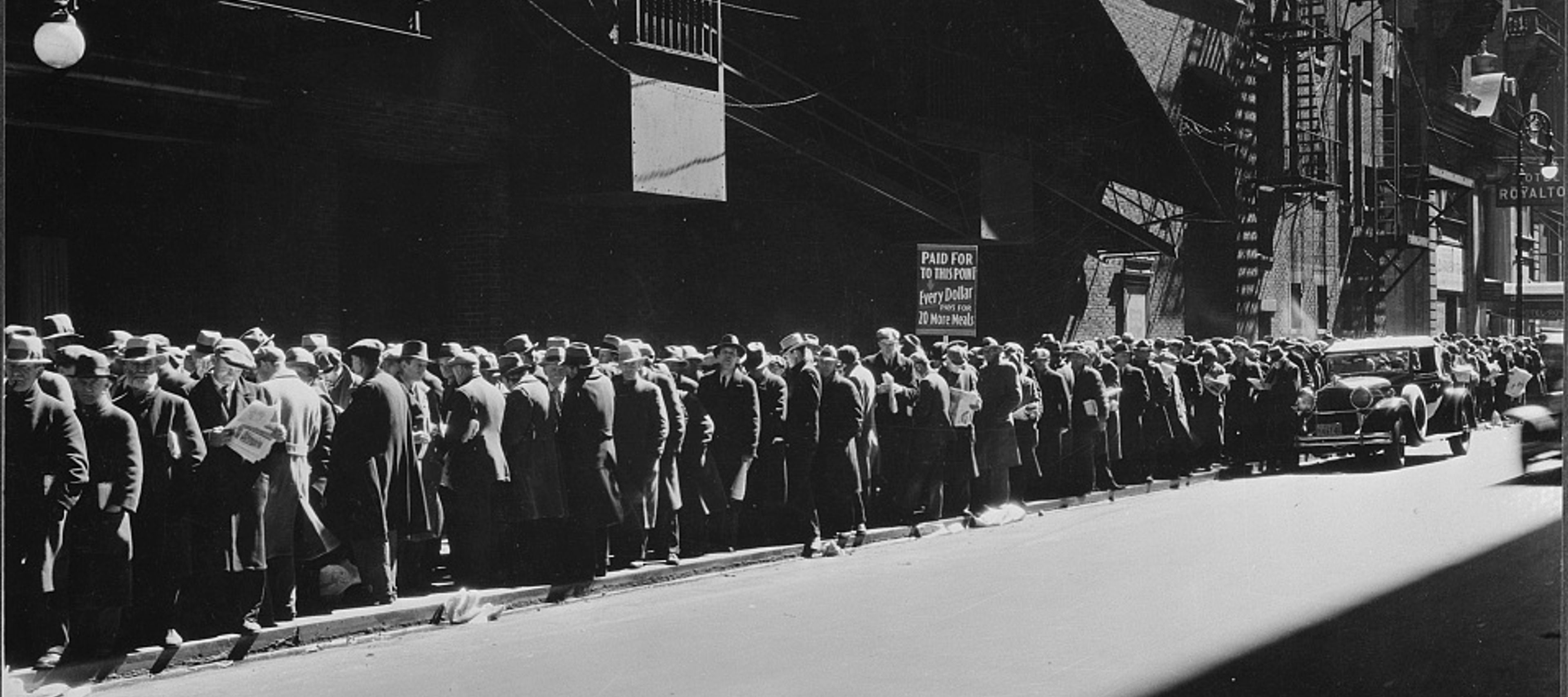
At its highest, the unemployment rate during the Great Depression reached 25% and many people lost their life savings as the banks failed. Families around the nation faced dire financial circumstances. This resulted in a wave of teenagers leaving home to support themselves, with many illegally riding freight trains around the country in search of employment. Many Americans lost their homes to foreclosure, became homeless, and had to rely on charity, like breadlines and other support services, to survive. “Hoovervilles”--shantytowns erected by those who had lost their homes--popped up around the country.
President Hoover employed several measures to combat the Great Depression, like supporting state efforts to combat the crisis and calling for volunteerism for aid outside the government. But as the Great Depression progressed, many people called for direct intervention by the federal government to respond to the economic crisis. President Hoover stated that this would lead to socialism and hurt morale in the country. During the 1932 presidential election, Americans showed their frustration with Hoover’s efforts by electing the Democratic Party nominee and New York Governor Franklin D. Roosevelt the 32nd President of the United States.
Music during this time was diverse, representing the various feelings related to the time period. Some songs, like “Brother, Can You Spare a Dime?” sung by Bing Crosby, “Detroit Moan” sung by Victoria Spivey, and “Over the Rainbow” sung by Judy Garland connect to the troubles of the Great Depression. Other music from the time period, like “Sing, Sing, Sing (With a Swing)” performed by Benny Goodman, “It Don’t Mean a Thing (If It Ain’t Got That Swing)” performed by Ella Fitzgerald and the Duke Ellington Orchestra, “Jeepers Creepers” sung by Billie Holiday, and “A-Tisket, A-Tasket” sung by Ella Fitzgerald provided an outlet to escape the troubles of the Great Depression for a little while.
Materials
- Students need a device with access to the internet.
Preparation
- Distribute Document Set – Scenario Primary Sources to each student electronically.
- Display Gallery Walk – Realities and Reactions around the classroom for Part 2 of the lesson.