
180 mins
The Red Scare: The Cold War at Home Featuring Pete Seeger
What was the Second Red Scare and how did life change for Americans at home during the height of Cold War tensions?
Essential Question
What was the Second Red Scare and how did life change for Americans at home during the height of Cold War tensions?
Objectives
Know (knowledge):
- The roots of domestic communism and anti-communism rhetoric in the United States during the 1950s
- How heightened domestic tensions and claims about perceived threats to democratic values led to widespread civil rights violations
- Resistance to McCarthyism and efforts to limit civil liberties
- The impact of policies at home during the Cold War, including the Space Race and Arms Race
Mastery Objective:
- Students will be able to describe the Second Red Scare, its impact and how daily life changed for Americans during the Cold War through the analysis of song lyrics, video clips, political cartoons, publications, and House Un-American Activities Committee (HUAC) hearing transcripts.
Background
In this lesson, students will investigate the Second Red Scare through Red Channels: The Report of Communist Influence in Television and Radio and singer-songwriter Pete Seeger. First, students will build context knowledge of McCarthyism and the Second Red Scare through newspaper headlines, films, and political cartoons. After examining the Second Red Scare, students will explore the Space Race, Arms Race, and other ways life at home was impacted by the Cold War.
In March 1947, President Harry Truman signed an executive order for “a purge of all government employees where there are ‘reasonable grounds’ to doubt their loyalty and set up sweeping new standards to test it”. This executive order would be one of the first events to kickstart a period of intense anti-communist fear and the repression of civil liberties known as the Second Red Scare and McCarthyism.
As fear of communist infiltration grew, it was not just government employees who were being investigated. The House of Un-American Activities Committee began investigating actors, directors, and other members of the Hollywood community in 1947; resulting in a group called the “Hollywood Ten” being blacklisted from working in film. In 1950, Red Channels: The Report of Communist Influence in Radio and TV was published. The names of members of the artistic community, like Lena Horne, Langston Hughes, Leonard Bernstein, Judy Holliday, and Artie Shaw, were published in the report, as well as their association, in what the report states were, “Channels (known to the Communist party as ‘transmission belts’) for pro-Soviet, pro-Communist, anti-American, anti-democratic propaganda”.
Folk singer Pete Seeger was also named in Red Channels for his association with organizations like People’s Songs, Progressive Citizens of America, Henry A. Wallace’s 1948 presidential campaign, and being an entertainer for a Communist Party event in 1946. Pete Seeger and his band member, Lee Hays, were brought before the House Un-American Activities Committee in August 1955.
The rising fear of domestic communism and resulting hunt for communists was not the only way life for Americans was changed during the height of Cold War tensions. As tensions grew between the Soviet Union and the United States, so did advancement in military technology as both sides worked to expand their arsenals, including nuclear weapons. This progress in military technology eventually informed the “space race” between the two nations, as technological innovation led humanity into outer space when the Soviet Union launched the first satellite, Sputnik 1 in 1957.
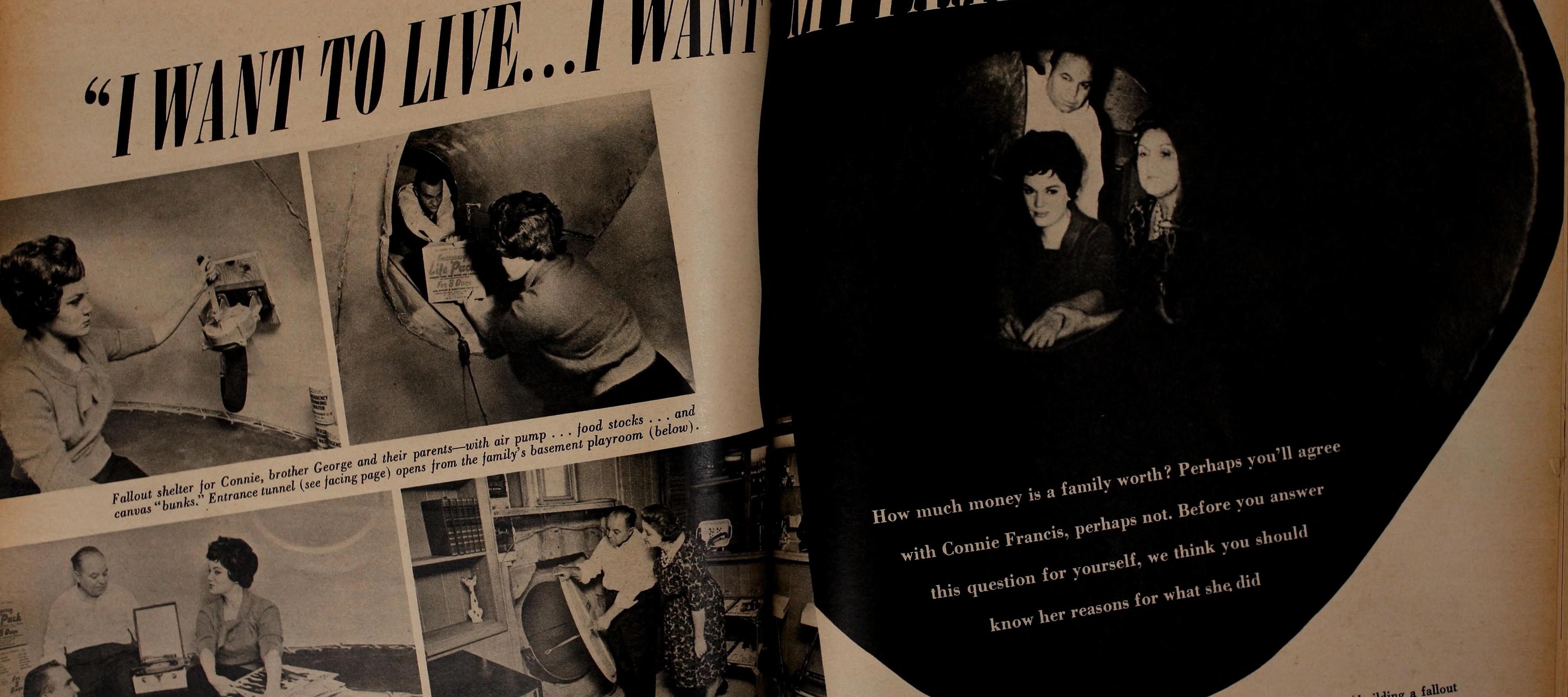
The arms and space races with the Soviet Union led to a fear of nuclear attack in the United States. Schools, cities, and towns conducted “duck and cover” drills to prepare in the event ofa possible nuclear attack. Fallout shelters were constructed as places where people could hopefully wait out nuclear fallout. In 1956, the National Interstate and Highways Act created the country’s national highway system to facilitate military movement and civilian evacuation in times of war.
Disclaimers
This lesson contains primary source documents and other materials that may include terms and images reflecting the attitudes, perspectives, and beliefs of different times that today are considered offensive and demeaning. TeachRock does not endorse the views expressed in these documents, but recognizes the value such materials provide for historical inquiry. For guidance on introducing controversial historical materials into the classroom, we suggest reviewing this document from the Library of Congress.
Materials
An internet accessible device for each student.
Preparation
- Print copies of Handout - Second Red Scare Background Timeline and cut out each newspaper clipping.
- Distribute the magazine, TV Radio Mirror (Oct. 1952) electronically to students.