
90 mins
The Spanish-American War's Impact on Cuba and Puerto Rico Featuring Bad Bunny
What was the impact of the Spanish-American War on Cuba and Puerto Rico and how is that impact still present in the 21st Century?
Essential Question
What was the impact of the Spanish-American War on Cuba and Puerto Rico and how is that impact still present in the 21st Century?
Objectives
Know (knowledge):
- The role of yellow journalism in the Spanish-American War
- Why the U.S. wanted to spread their sphere of influence to Cuba and Puerto Rico at the turn of the 20th Century
- The outcome of the Spanish-American War and its impact on Cuba and Puerto Rico
- How the effects of American imperialism are still present in Puerto Rico in the 21st Century
Mastery Objective
- Students will be able to identify and analyze the impact of the Spanish-American War on Cuba and Puerto Rico through the examination of newspaper headlines, amendments, and a music video.
Background
In this lesson, students will participate in a press conference scenario and examine newspaper headlines to identify why the Spanish-American War started. Students will then analyze amendments and Bad Bunny’s “El Apagón” music video to identify the impact of American imperialism after the Spanish-American War. Students will complete the lesson with an activity investigating the reliability of internet sources.
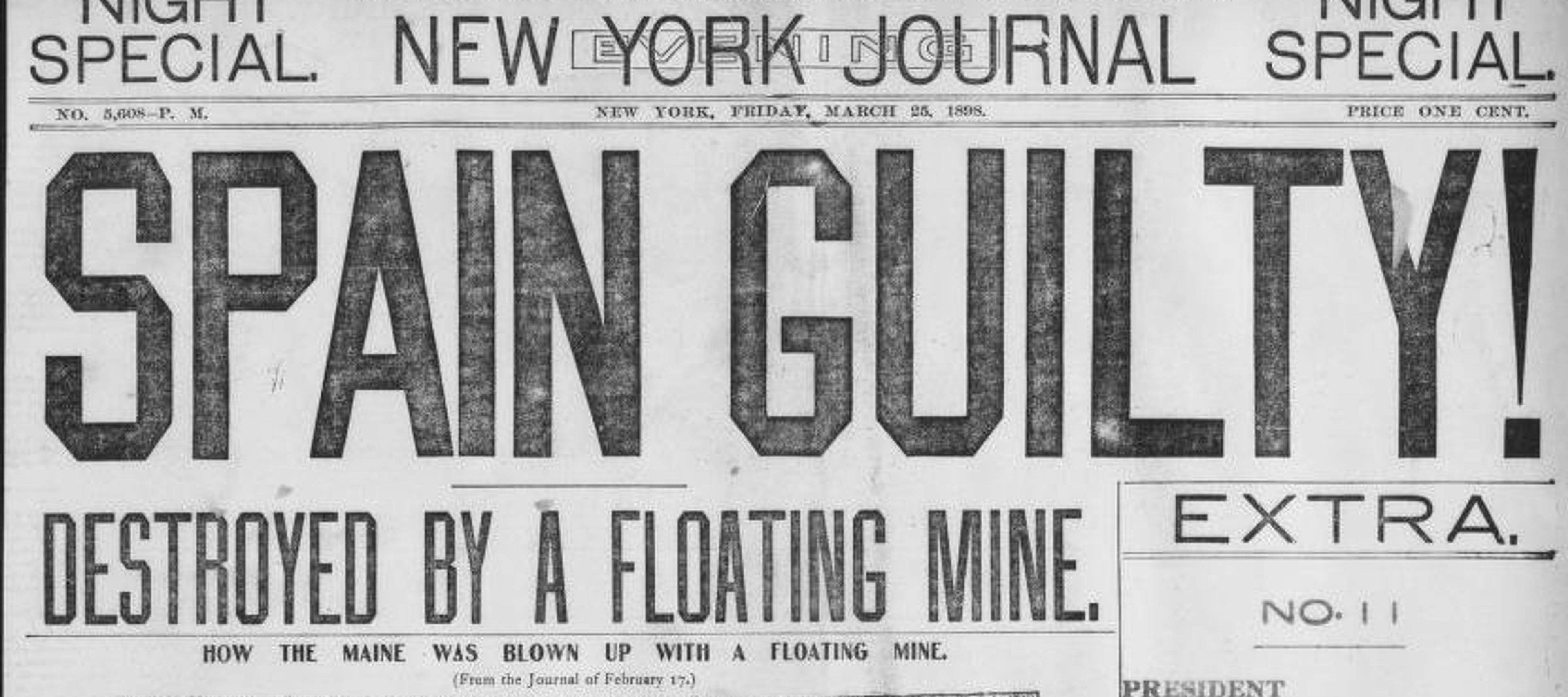
Fake news and clickbait are not new to the digital age and the 21st Century. In the late-19th Century, newspapers like the New York World and New York Journal used exaggerated and eye-catching headlines to sell newspapers. Publishers Joseph Pulitzer (New York World) and William Randolph Hearst (New York Journal) included stories with melodrama, romance, and hyperbole in their publications in order to attract more customers. During the 1890s, these newspapers included articles about the Cuban revolution and atrocities against the Cubans by colonial Spain to pull at the heart strings of their readers. When the USS Maine exploded in Havana Harbor in February 1898, the New York Journal printed multiple daily editions blaming Spain, even though the paper had little evidence. Headlines like “Spain Guilty!”, which took up one third of the Journal’s front page, and “Torpedo Hole Discovered by Government Divers in the Maine” worked to influence public opinion that the United States must intervene in the region.
Ultimately, the U.S. did intervene and the Spanish-American War began. The war was a brief conflict of less than 8 months, but the results for the United States were transformative. The Treaty of Paris of 1898 passed control of Cuba, Puerto Rico, Guam, and the Philippines from Spain to the United States. Before the United States declared war on Spain, the Teller Amendment stated that the United States had no intention to “exercise sovereignty, jurisdiction, or control over said Island” (Cuba) and the U.S. would “leave the government and control of the island to its people”. However by 1902, the U.S. military was not leaving the island until Cuba agreed to add the Platt Amendment to their new constitution.
The Platt Amendment included several stipulations about the future of Cuban and U.S. relations. The amendment limited Cuba’s right to enter into treaties with other countries, permitted the U.S to lease or buy lands for the purpose of establishing naval bases, and the U.S. would intervene in Cuban affairs for the “preservation of Cuban independence”. The Platt Amendment was reversed in 1934, although the U.S. still maintains the Guantanamo Bay Naval Base in Cuba.
Unlike Cuba, the island of Puerto Rico became a U.S territory in 1917 as a result of the Treaty of Paris, and the island is still entwined with the United States in the 21st Century as an unincorporated territory. While Puerto Ricans are U.S. citizens, they cannot vote in U.S. presidential elections and they do not have a voting representative in Congress. Puerto Rico has some benefits of U.S. statehood, including federal funds like Medicare and Social Security, but they don’t qualify for federal bankruptcy assistance like states do. The precarious state of the island has become especially relevant in the 21st Century as Puerto Ricans deal with economic depression, shrinking population, a debt crisis, the COVID-19 pandemic, and various natural disasters.
The lasting impact of U.S. imperialism in Puerto Rico can be seen in Bad Bunny’s music video, “El Apagón”. The music video begins as a celebration of Puerto Rican culture and then becomes a mini documentary where the people of Puerto Rico speak out about being removed from their homes, the privatization of beaches, and other issues impacting the territory today.
Preparation
- Display Gallery Walk - Newspaper Headlines around the classroom
Connected Themes
Artist(s)
Genre(s)
Decade/Era
Monthly Theme