
90 mins
The United Farm Workers Movement through Music and Poetry
Who is Dolores Huerta, what role did she play in the United Farm Workers movement, and how is she recognized today?
Essential Question
Who is Dolores Huerta, what role did she play in the United Farm Workers movement, and how is she recognized today?
Objectives
Know (knowledge):
- The historical conditions that led to the United Farm Workers’ struggle for labor rights
- The significance of the United Farm Workers movement as a historical event
- The role of women in the United Farm Workers movement and the role played by Dolores Huerta in particular
- How these historical events and figures are recognized and remembered today
- The role music played in the United Farm Workers movement
Mastery Objective:
- Students will be able to describe the ways in which the United Farm Workers movement and Dolores Huerta have contributed to contemporary Civil Rights issues and to the feminist movement by examining how poetry and music by Diana Garcia, Nikki Darling, and Alice Bag reflect the movement and its figures. Students will also draw connections between the songs and poems and contemporary struggles for the recognition of marginalized groups.
Background
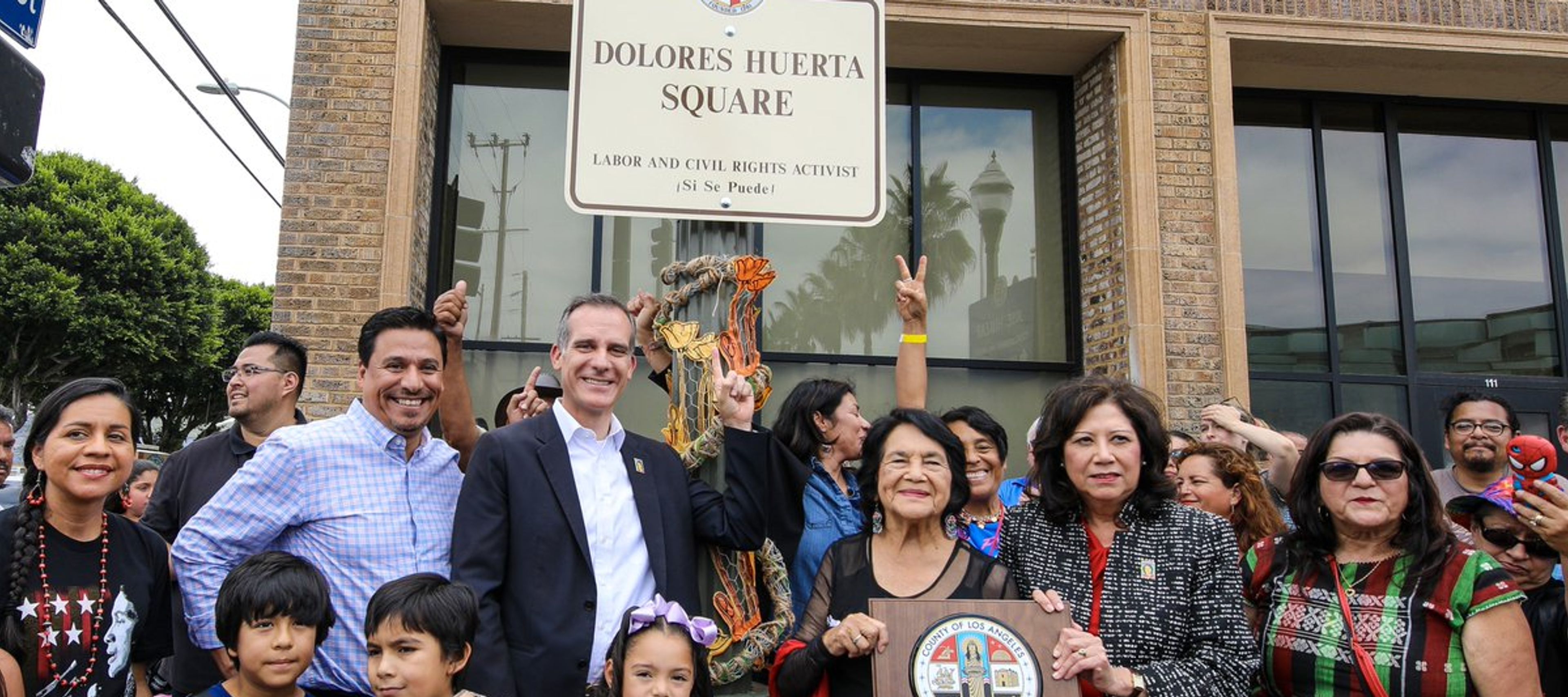
In this lesson, students will examine the lyrics and context surrounding Nikki Darling’s poem, “A Street Called Dolores Huerta” and Alice Bag’s song of the same name. Students will use the work of these artists as a lens through which to consider the importance of the United Farm Workers movement and to discuss the legacy of Dolores Huerta, one of the movement’s central figures.
Migrant labor has been essential for the agricultural industry in western states such as California, Oregon, Washington, Arizona, or New Mexico. In the 20th century, Chinese, Japanese, Filipino, and Mexican immigrants performed much of the agricultural work in the western United States. The Bracero Program alone brought 5 million Mexican workers to the U.S. from 1942 to 1964 in an effort to solve labor shortages caused by World War II. Agricultural work was low-paid, physically demanding, and dangerous. The workers and their families lived in poverty and lacked educational opportunities. They faced violence and discrimination when they sought fair treatment and reasonable living conditions.
Cesár Chávez (1927-1993) and Dolores Huerta (1930-) were the children of agricultural workers and were familiar with the challenges they faced. Chávez had even dropped out of school in the 8th grade in order to work to support his family. Both Chávez and Huerta were deeply committed to community organizing and fighting social and economic injustice. Together, in 1962 they launched the union that became known as the United Farm Workers to establish better pay and working conditions. The UFW understood that although the workers were very poor, they were able to wield significant power at the ballot box, through grassroots organization, and through boycotts. Over the course of the 1960s and 1970s, the UFW made great gains for workers’ rights by establishing disability insurance for farmworkers, fighting the use of dangerous pesticides, raising wages, and eventually passing the Agricultural Labor Relations Act of 1975, which granted farmworkers the right to collectively organize. The farmworkers’ movement became so influential that Miriam Powell called it “the civil rights movement of the West.”
One of the most successful boycotts was the National Boycott of California Table Grapes, which began as a Filipino workers’ strike in 1965. To support the strike, the UFW organized a boycott of table grapes. Dolores Huerta’s organizational skills were instrumental to this effort. She led picket lines and traveled to cities across the country to publicize the boycott and encourage the public not to buy grapes without union labels. The cause was boosted by the Civil Rights movement, which had increased public awareness regarding lowered standards of living for victims of racism and prejudice. Civil rights organizations, faith groups, student activists, and even politicians such as Robert F. Kennedy brought attention to the UFW’s cause. Soon, millions of consumers had joined the boycott and stopped buying table grapes. As a result, grape growers signed the first union contracts and brought social justice to agricultural labor. Yet while the United Farm Workers movement vastly improved working conditions, agricultural workers today still face low pay and high levels of discrimination and violence. They are still predominantly migrant workers and are often exploited by their employers, who ignore labor laws and fair practices.
Dolores Huerta faced particular challenges as a woman in the predominantly male space of politics. For Huerta, fighting for gender equality was just as important as fighting for social and economic equality. Huerta fought gender discrimination within the UFW, where women were often constrained by the traditional views and gender expectations of their fathers or husbands. Huerta advocated for the participation of the entire family in the movement. After all, she argued, men, women, and children worked in the fields together. Following Huerta, women devoted their efforts to organizing at a grassroots level by joining the picket lines, organizing marches and boycotts, rallying for changes to legislation and policy, and registering Latinos to vote. Many of the tactics that the UFW pioneered have been adapted by other groups, from environmentalists to advocates for immigrants’ rights. Huerta’s slogan, ¡Si, se puede! (Yes, we can!), was even adopted by President Barack Obama in his presidential campaign.
Music played a central role in the grassroots efforts of the UFW. Songs provided a sense of community and connection for the movement, as the workers would sing at union meetings and as they marched or stood on the picket line. Some of the songs, such as "De Colores" or "Solidarity Forever," were traditional Spanish and American folk songs. Other songs, such as "El Picket Sign," were written expressly for the movement by the Teatro Campesino, the cultural arm of the United Farm Workers. Music has also played a role in commemorating the movement and in recognizing Huerta’s important contributions over sixty years of activism.
Connected Themes
Artist(s)
Topics
Decade/Era
Monthly Theme