
90 mins
Who Owns a Movement? Political Protest Songs and Copyright
What does the legal dispute over the song “We Shall Overcome” reveal about the complexity of copyright law?
Essential Question
What does the legal dispute over the song “We Shall Overcome” reveal about the complexity of copyright law?
Objectives
Know (knowledge):
- How “We Shall Overcome” was created from a political movement
- That licensing and copyright agreements allow publishers to financially benefit from the proceeds of a song
- The definition of “public domain”
Mastery Objective
- Students will be able to identify the reasons why the song “We Shall Overcome” was placed into the public domain as well as explore the lasting impact of “ownership” on a political movement and protest song.
Background
In this lesson, students will consider the implications of copyright and intellectual property within a political movement by formulating a persuasive argument as to who owned the song “We Shall Overcome” after researching primary and secondary sources.
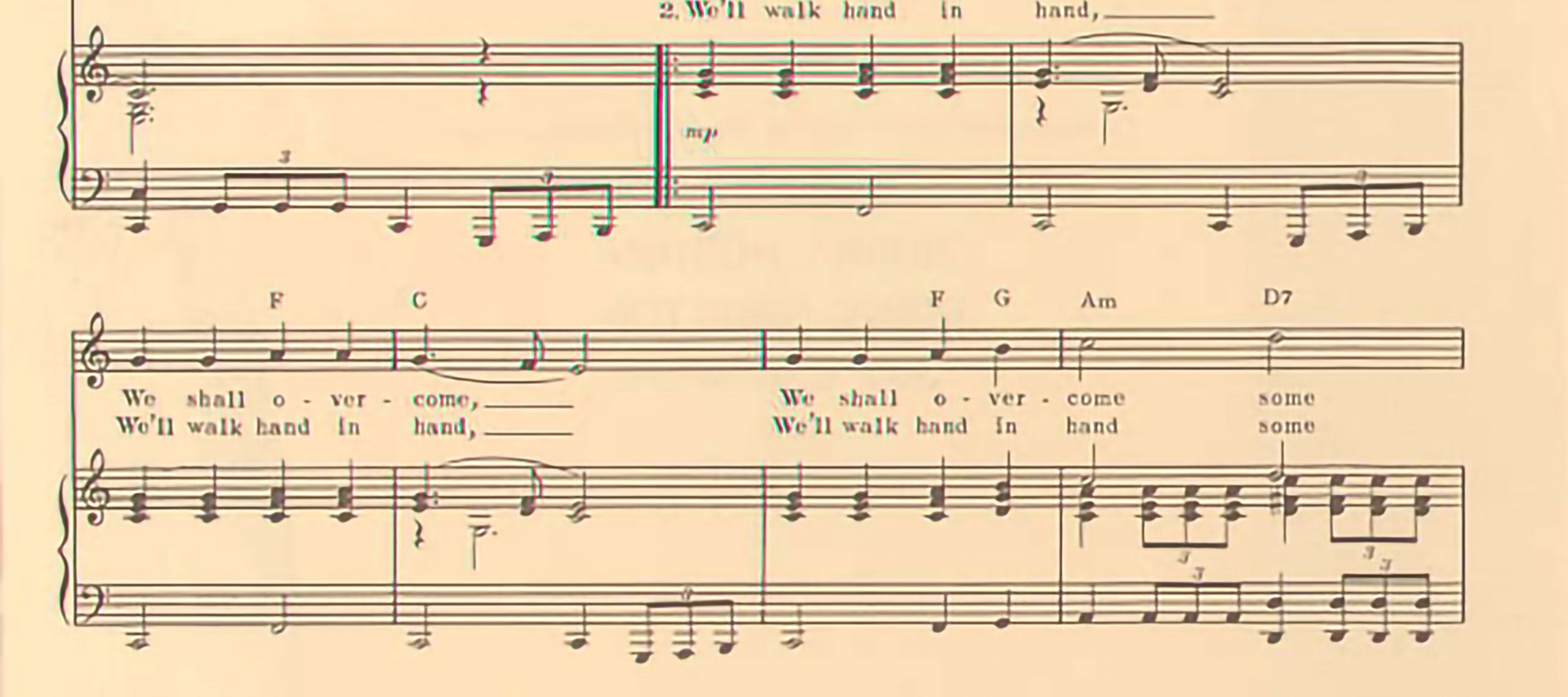
There is perhaps no greater musical signifier of the Civil Rights Era than the song, “We Shall Overcome.” Based upon an older Black spiritual, the song became–with the help of people like Pete Seeger and the Student Nonviolent Coordinating Committee–the anthem for the Civil Rights Era. And while the song remains iconic today, many do not know that it was the cause of an intense legal battle over copyright.
Folk musicians Pete Seeger, Guy Carawan, and Frank Hamilton first registered the copyright for “We Shall Overcome” in 1960. However, the song can be directly linked back to two previous songs; the lyrics from “I’ll Overcome Some Day” written by the Reverend Charles Tindley in 1903, and the melody from a traditional African American gospel song titled, “I’ll Be All Right.” Pete Seeger first heard “We Shall Overcome” in 1948 from a folk singer and activist at the Highlander Folk School in Tennessee, Zilphia Horton. She in turn heard a protester, Lucille Simmons, sing the song at a labor protest in South Carolina. Horton was struck by the simplicity of the tune, and Simmons is credited for changing the lyric from “I” to “We.”
In the same year, Guy Carawan learned the song “We Shall Overcome” from a large group of students at a conference in Highlander Folk School. The students were part of the Student Nonviolent Coordinating Committee (SNCC), a political organization fighting for civil rights by staging protests across the south.
While the song was being sung as part of protests, Seeger, Carawan, and Frank Hamilton determined to copyright their version of “We Shall Overcome” so that all royalties from the song could be used to raise funds for the Civil Rights Movement. Once copyrighting the song, they established the We Shall Overcome Fund, a nonprofit which provides grants “to nurture grassroots efforts within African American communities to use art and activism against injustice.”
In 2013, the producers of the film Lee Daniels’ The Butler wanted to license the use of “We Shall Overcome” in the movie. Finding the $100,000 licensing fee that the song’s copyright holders were requesting to be excessive, the film’s producers joined a previous federal lawsuit brought by an independent filmmaker in 2016, which sought to nullify the song’s copyright protection. The resulting court case, We Shall Overcome Foundation and Butler Films, LLC v. The Richmond Organization, Inc. (TRO, Inc.) and Ludlow Music, Inc. was settled in 2018. As part of the settlement, “We Shall Overcome” was placed into the public domain - meaning its copyright protection was nullified and it was now freely available for anyone to use, copy, and adapt without need for permission.
Connected Themes
Artist(s)
Genre(s)