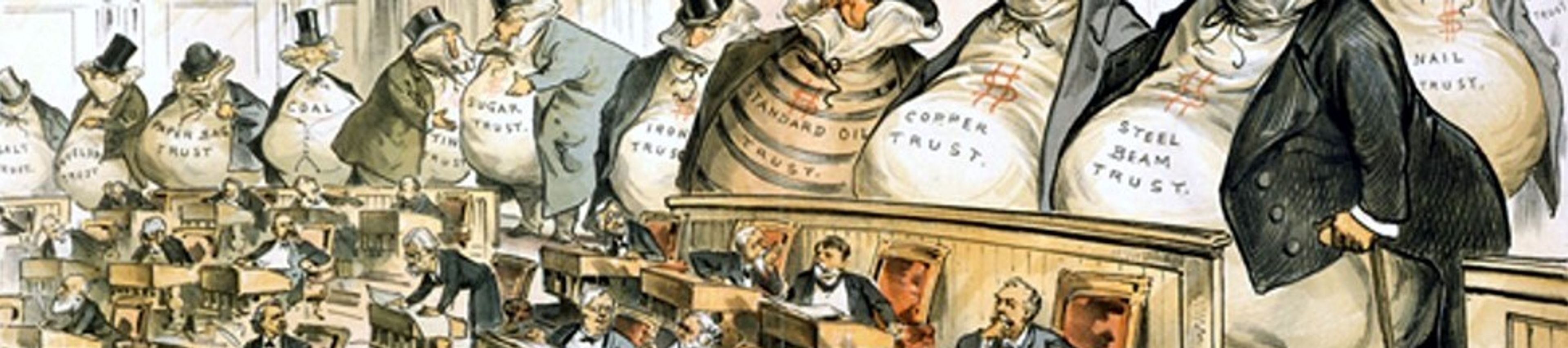
This is the famous 1889 political cartoon titled "The Bosses of the Senate" by Joseph Keppler.  The illustration depicts the United States Senate chamber, split into two distinct levels of power:  The Senate Floor: In the foreground, dozens of small, diminutive Senators sit at their desks, looking overwhelmed, distracted, or subservient.  The "Bosses": Looming over the Senators in the back of the room is a row of massive, bloated figures shaped like money bags. These giants represent the various industrial monopolies of the Gilded Age, with labels across their stomachs such as "Standard Oil Trust," "Copper Trust," "Steel Beam Trust," and "Sugar Trust."  The Entrances: On the far left, a small door labeled "People’s Entrance" is barred and carries a "Closed" sign. Meanwhile, the giants enter through a large, wide-open door on the right labeled "Entrance for Monopolists."  The Banner: Hanging on the back wall is a sign that reads: "This is a Senate of the Monopolists, by the Monopolists, and for the Monopolists!"—a cynical play on the Gettysburg Address.  The cartoon is a biting critique of corporate influence on the American legislative process, suggesting that the government of the era served the interests of wealthy trusts rather than the general public.
Topic

Gilded Age

Explore the rapid industrial growth, economic disparity, and political corruption of America's Gilded Age (1870s–1900).

Loading...
