
90 mins
Calculating Pitch
How do musical instruments produce different pitches, and what variables allow you to calculate the pitch of an instrument?
Essential Question
How do musical instruments produce different pitches, and what variables allow you to calculate the pitch of an instrument?
Objectives
Know (knowledge):
- The musical instrument the beam
- The definition of pitch
- How pitch can be represented mathematically
- How to define and calculate for an instrument’s fundamental frequency
- What variables dictate the pitch an instrument produces (tension, mass, size/length)
- How different pitches are created by manipulating the variables of an instrument
Mastery Objective:
Students will be able to analyze and explain how the variables of an instrument affect the pitch it produces by experimenting with the calculation for fundamental frequency.
Background
In this lesson, Mickey Hart’s beam instrument is used as a model to calculate how strings produce pitch. After creating and playing a model version of the beam, students are introduced to the variables that determine the fundamental frequency a string produces, and manipulate a mathematical equation to solve real-world problems related to the construction and performance of the beam.
In the lesson The Mathematics Behind Sound, students calculated and visually represented the differing sound qualities of various musical instruments. Yet, anyone who has sat in front of a piano or listened to a guitar solo knows that even a single instrument is capable of producing a wide variety of sounds.
This lesson focuses particularly on pitch or frequency, and the variables in a single instrument’s construction that contribute to the pitches it is capable of producing.
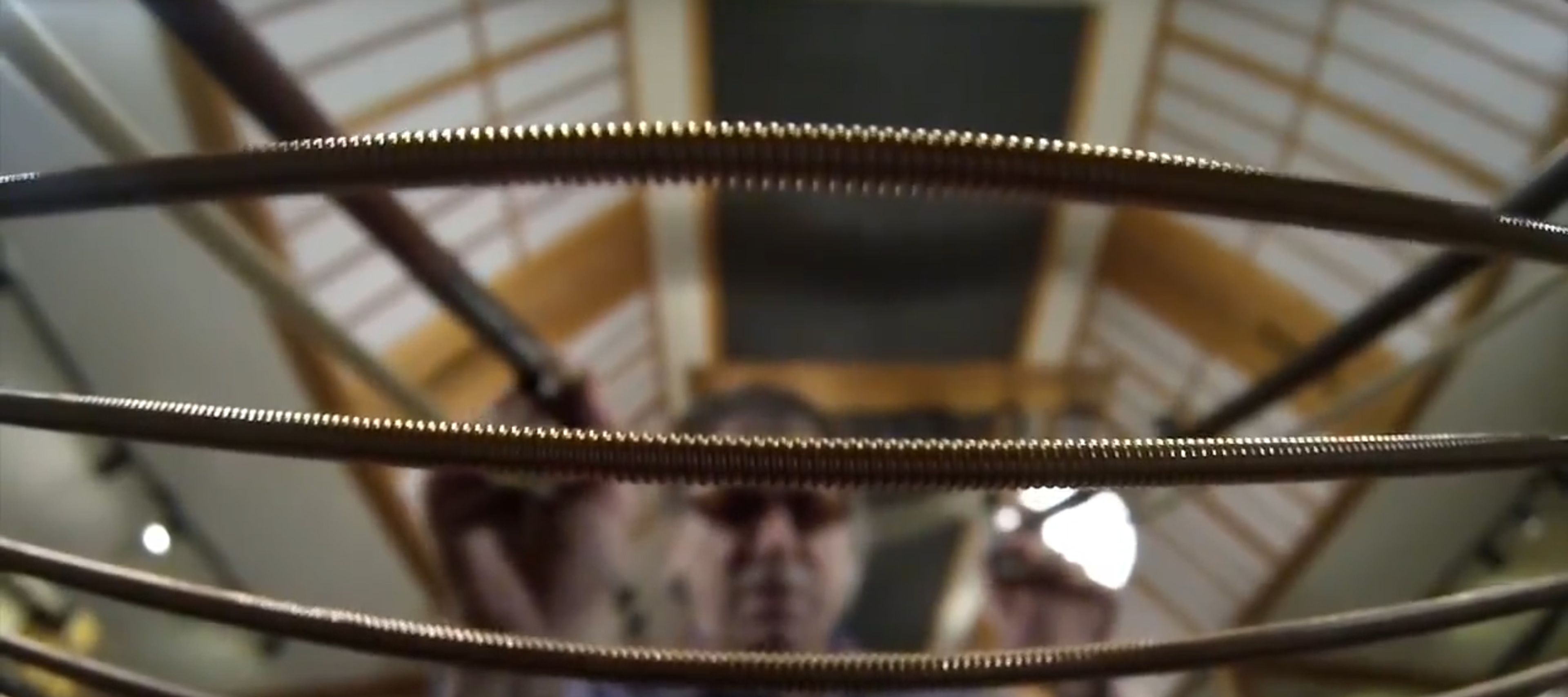
The instrument that will serve as a case study for this lesson is the “beam” or “blaster beam.” Measuring over 8 feet in length and capable of playing some of the lowest pitches humans are able to hear, the beam is a metal construction beam with 13 bass piano strings stretched over it, and a pickup to amplify their sound. The instrument was invented by John Lazelle and refined by Craig Huxley in the 1970s, and its otherworldly sound has been featured in multiple science fiction, fantasy, and horror films, including the Star Wars and Star Trek series, 2010, and 10 Cloverfield Lane. Mickey Hart first discovered the instrument while working on the soundtrack to the film Apocalypse Now.
Despite the immensity of the beam’s size and the sound it produces, it is a relatively simple instrument. The 13 bass piano strings on the beam are all tuned to the same note, making it an electrified version of the monochord - an open stringed instrument that traces as far back as the ancient Sumerian civilization (ca. 5500-1900 BCE). By experimenting with the monochord, Greek philosopher Pythagoras (c. 570- c. 490 BCE) developed mathematical principles and early scientific concepts not only related to music, but the entire universe. The fact that the beam serves as a sort of present-day monochord makes it the ideal instrument to examine the mathematics behind pitch, in the same way Pythagoras did millennia ago.
Materials
- Push pins
- Rubber bands of various sizes and thicknesses
- Empty tissue boxes
Connected Themes
Artist(s)
Genre(s)