
90 mins
The Asian American Immigrant Experience at the Turn of the 20th Century featuring Hollis Wong-Wear
How have Asian immigrants and their descendants been uniquely affected by U.S. immigration policy, and how have the arts provided a source of strength and resiliency for Asian Americans confronting a history of prejudice and xenophobia?
Essential Question
How have Asian immigrants and their descendants been uniquely affected by U.S. immigration policy, and how have the arts provided a source of strength and resiliency for Asian Americans confronting a history of prejudice and xenophobia?
Objectives
Know (knowledge):
- The history of Asian American immigrants within the United States, beginning with the California Gold Rush of the mid 19th century
- U.S. immigration policy relating to Asian American immigrants, including the Naturalization Law of 1790, the People V. Hall court case of 1854, the Page Act of 1875, the Chinese Exclusion Act of 1882, and the Geary Act of 1892
- The historical significance of the Angel Island Immigration Station
- How the creative work of Hollis Wong-Wear, Kevin Yang, Huang Ruo, Michelle K. Hanabusa, and the anonymous detainees at Angel Island provide a source of strength, resiliency, and protest for Asian Americans
Mastery Objective
- Students will be able to identify how Asian Americans have used the arts to protest the history of Anti-Asian immigration policy by hearing spoken word, reading poetry, listening to music, and analyzing streetwear fashion.
Background
In this lesson, students investigate U.S. immigration policy toward Asian American immigrants in the late 1800s to early 1900s. They discover the history of the Asian American immigrant experience during this time period, and consider the motivations and effects of legislation such as the Page Act of 1875, Chinese Exclusion Act of 1882, and the Geary Act of 1892. Students take a “virtual tour” of the Angel Island Immigration Station, which processed thousands of Asian American immigrants. Finally, they examine how Asian Americans in the past and present use poetry, music, and fashion as a means to confront, remember, and challenge racism and anti-Asian prejudice.
In 2023, the Pew Research Center published a survey finding that 9 in 10 Asian Americans have reported experiencing racial discrimination in their lives. Within that group, 78% reported being treated as a foreigner in some way, even if they have lived in the United States all their lives. Following the COVID-19 pandemic and the increase in hate crimes toward Asian Americans, the survey reported that one third of respondents feared threats or physical violence. As one respondent commented, “even when I was just getting on the bus, [people acted] as if I was carrying the virus. People would not sit with me, they would sit a bit far. It was because I look Chinese.”
Asian Americans have confronted accusations of being perpetually foreign, “alien,” or unclean throughout American history. In 1870, for example, California U.S. Senator Cornelius Cole stated, “When I look upon a certain class of Chinese who come to this land - I mean the females - who are the most undesirable of the population, who spread disease and moral death among our white population, I ask myself the question, whether or not there is a limit to this class of immigrants?”
Cole’s sentiment was shared among members of Congress during his time. In 1875, Congress passed the Page Act, which effectively banned single Asian women from immigrating to the U.S. In 1882, Congress went further and passed the Chinese Exclusion Act, the only restrictive piece of U.S. immigration legislation targeting a single ethnicity. The Act remained in effect until 1943.
To enforce regulations such as the Page and Chinese Exclusion acts, institutions such as the Angel Island Immigration Station were established. Just off the coast of San Francisco, this station processed thousands of Asian American immigrants, largely from countries such as China, Japan, Punjab, Russia, and the Philippines. Asian American immigrants coming to the station often faced months of detainment, harsh interrogations, and invasive health screenings before ultimately being accepted into the U.S., or deported.
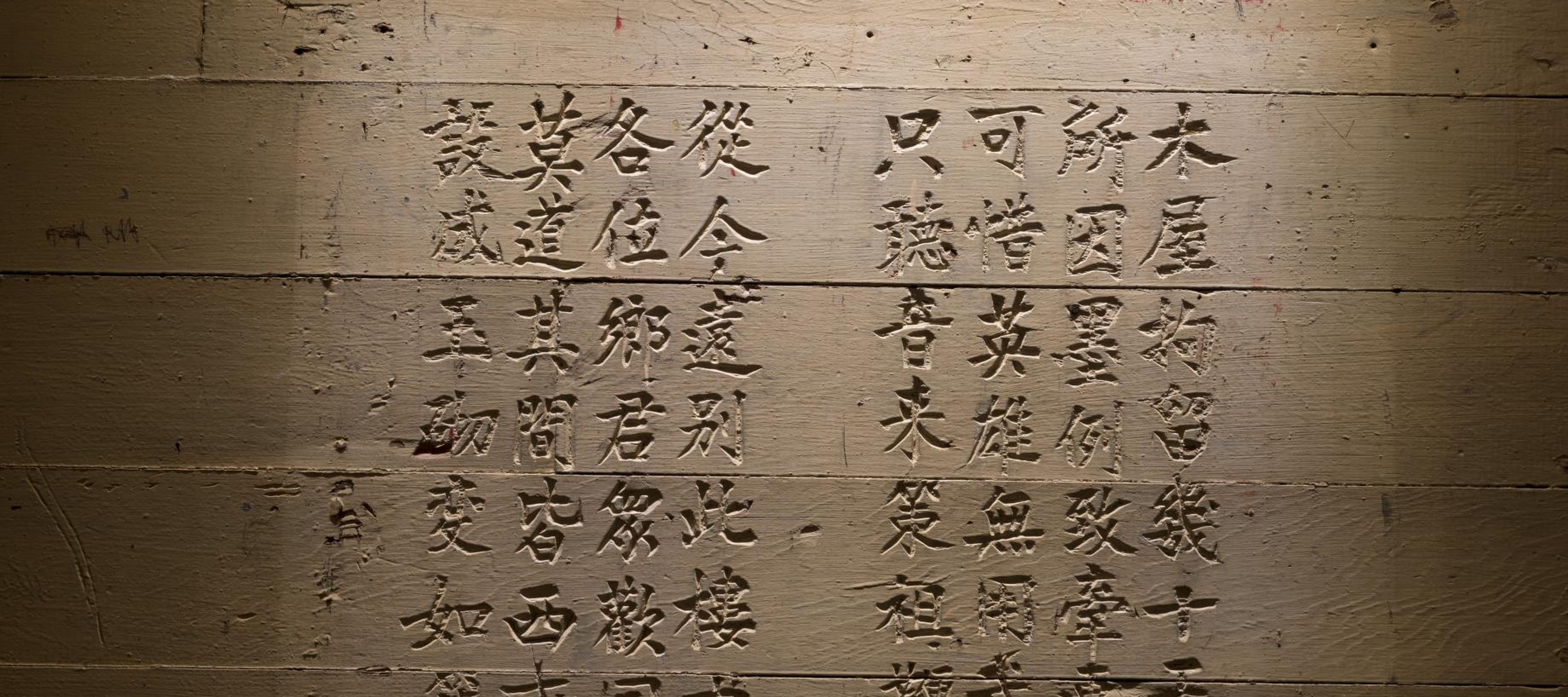
In the face of these challenges, Asian American immigrants and their children have often turned to the arts as a source of protest, strength, and resiliency. The walls of Angel Island are famously carved in Chinese characters - poetry written by often anonymous detainees expressing their wide range of feelings. During the 1960s Asian American Civil Rights Movement, musicians such as Charlie Chin wrote songs and ballads reminding people of the history of Asian persecution in the United States. Today, poets, rappers, composers, and fashion designers such as Hollis Wong-Wear, Kevin Yang, Huang Ruo, and Michelle K. Hanabusa continue to use the arts as a source of Asian American pride and a vehicle to fight for equality and racial justice in the United States.
Preparation
- Print and hang images from Gallery Walk - Angel Island Immigration Station Virtual Tour around the classroom. Alternatively, you can display the images on devices around the room.
Connected Themes
Genre(s)
Topics
Decade/Era
Monthly Theme