
90 mins
The Rise of Populism and Socialism featuring Oliver Anthony
What criticism did the Populist and Socialist Party have of the U.S. government and economy at the turn of the century, what solutions did they offer, and how have musicians since made similar critiques?
Essential Question
What criticism did the Populist and Socialist Party have of the U.S. government and economy at the turn of the century, what solutions did they offer, and how have musicians since made similar critiques?
Objectives
Know (Knowledge)
- That the Populist and Socialist parties arose from a shared feeling of alienation and disenfranchisement among working class Americans in the late 1800s
- The historic role Mary E. Lease, William Jennings Bryan, and Eugene V. Debs played in the Populist and Socialist movements
- While both parties critiqued similar issues, they approached solutions in a different way
- While both parties failed electorally for the most part, they succeeded in transforming popular consciousness in the United States, ushering in the Progressive Era
- Many of the issues brought up by the Socialist and Populist parties continue to be present today, and are often articulated by musicians
Mastery Objective
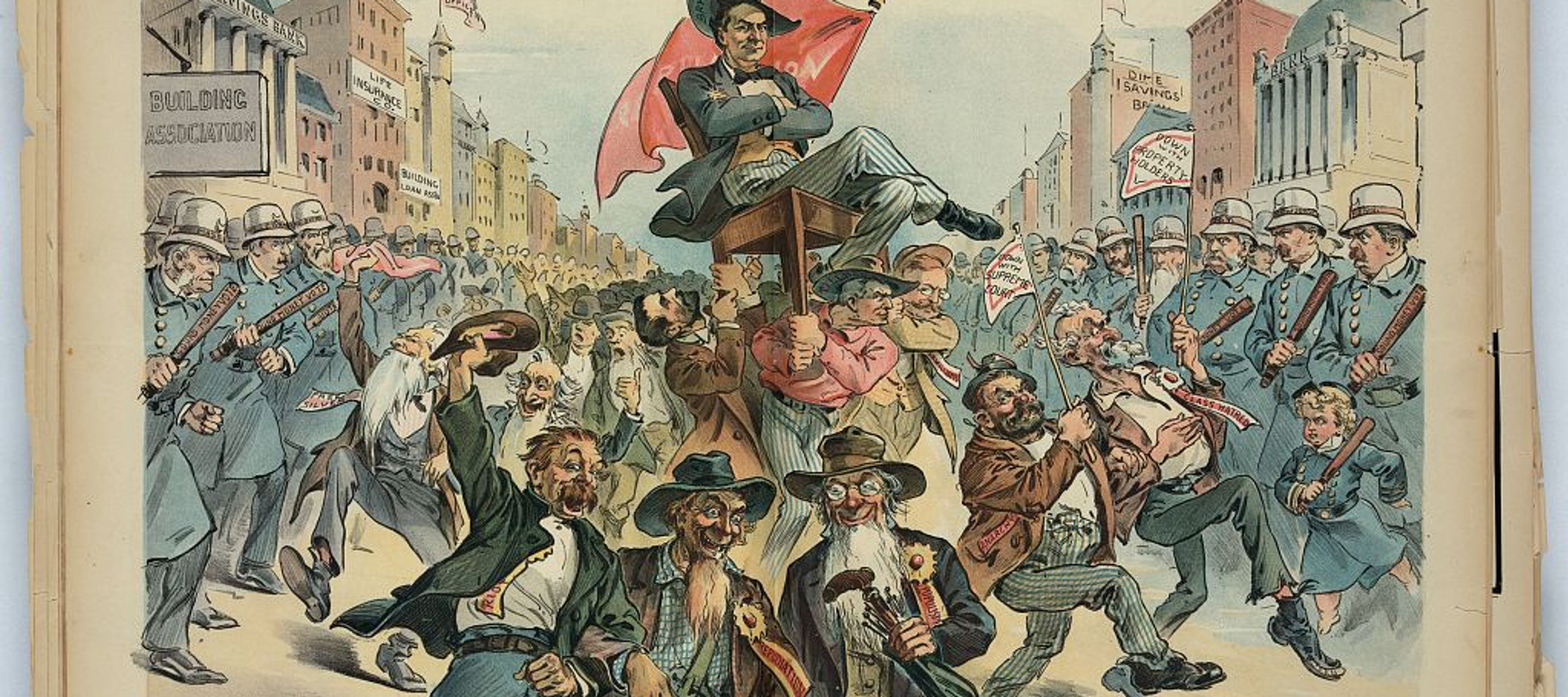
- Students will be able to detail the critiques and platform of the Populist and Socialist movements in the United States at the turn of the twentieth century, and identify how those critiques continue to the present by analyzing charts, examining political cartoons, and reciting political speeches.
Background
In this lesson, students examine charts, analyze political cartoons, and recite excerpts of political speeches to uncover the Populist and Socialist parties’ critiques of, and solutions to, economic issues confronting Americans in the late 1800s. They also compare the critiques of the Populist and Socialist parties to Oliver Anthony’s 2023 song “The Rich Men North of Richmond” to determine if the issues underlying these historic movements are still relevant today.
In August 2023, Christopher Anthony Lunsford – known by his stage name Oliver Anthony - was propelled into stardom after releasing a video of his song, “The Rich Men North of Richmond” on the YouTube channel radiowv. The video became a viral hit, and the song soon topped streaming charts and debuted at No. 1 on the Billboard Hot 100 chart.
While Anthony’s powerful vocals and songwriting ability certainly aided the song’s popularity, the lyrics to “The Rich Men North of Richmond” seemed to have tapped into a feeling many shared about the state of U.S. politics and society at the time – as evident by the prolific and often contentious discussion around the song’s lyrics on social media and in the press. In short, the lyrics to the song portray a juxtaposition between the poverty of honest, hard working Americans and the enormous wealth and corruption of politicians and the politically well-connected in Washington D.C., the city almost directly north of Richmond, Virginia. It is a struggle Anthony, who worked various industrial factory jobs before his career as a musician, has certainly experienced.
In the song, Anthony seems to attribute the difficulties working class people are forced to contend with as a part of “Livin’ in the new world.” But historians may have grounds to disagree with this notion. In U.S. history, one can easily find similarities between the message in “The Rich Men North of Richmond” and the messages delivered over one hundred years ago by figures such as Mary E. Lease, Eugene V. Debs, and William Jennings Bryan. Lease, Bryan, and Debs all lived during a similar time of great upheaval, when technological innovation disrupted the U.S. economy and threatened the financial stability of working people.
Despite different upbringings, Bryan, Debs, and Lease landed upon roughly the same diagnoses for the American economy at the turn of the century: that wealthy industrialists had rigged the economy and corrupted politicians so that they could attain ever higher wealth, while workers and farmers increasingly struggled. Gifted orators, each figure barnstormed the country spreading their message, and in the process, helped create the Populist and Socialist parties.
Born to Irish immigrants in 1850, Mary E. Lease lost her father, uncle, and two brothers to the Civil War. She also lost two of her children while living as a farmer in Kansas and Texas before a bank foreclosed on her property. Given her experience, Lease quickly fell in with the Farmers’ Alliance, a group of almost a million farmers that collectively demanded an end to the “tyranny of monopoly” over land they felt was held by bankers and railroad owners. By 1892, Lease helped transition the Farmers’ Alliance into the People’s Party, which proved to be the most successful Third Party in U.S. history.
The success of the People’s Party had a great amount to do with William Jennings Bryan. A lawyer and orator by trade, Bryan was elected into Congress at 30 years old, gaining the nickname “Boy Bryan” in the process. More than any other figure (and much to Lease’s dismay), Bryan was able to merge much of the platform of the People’s Party into the Democratic Party platform.
Born in 1855 in Terre Haute, Indiana to French immigrants, Eugene V. Debs started working for railroad companies at the age of 14, and for decades of his life became a staunch defender of railroad companies. Debs had a change of heart beginning in 1886 during a railroad strike against the Chicago, Burlington, and Quincy Railroad, and soon began organizing the American Railroad Union (ARU). In 1894, after the Pullman Company that made train cars refused to negotiate with the ARU, Debs and others called for a national boycott of the company – only to be arrested and imprisoned by the federal government under President Grover Cleveland on conspiracy charges. Experiencing such repression further radicalized Debs, and upon being released from prison he established the Social Democratic Party, and later the Socialist Party of America, and ran for president multiple times through the party.
While the Populist Party and Socialist Party shared a similar outlook on the causes of the economic strife plaguing the country, they offered different solutions. For the Populists, the issue wasn’t Capitalism itself, but monopolism caused by governmental corruption. The solution was to develop a Capitalist system that provided equal support to working people and small time farmers through a variety of laws and policies. For the populists, one way to achieve this was by moving towards a “bimetallist” economic system that tied the US dollar to a standard other than just gold, which, they believed, would increase the flow of money.
Debs and the socialists, on the other hand, were more inclined to the opinion that Capitalism naturally led to monopolism, and there were little to no legal interventions that could prevent that transition. Thus, they advocated for a slow transformation of the entire economic system in the U.S. from one led by business owners to one led by an organized group of workers.
As historian Jill Lepore writes, “Populism entered American politics at the end of the nineteenth century, and it never left.” Even though Lease never held public office, and both Bryan and Debs failed to win the presidency, the issues Populists and Socialists articulated at the turn of the century drew a rhetorical line between the working class and the wealthy. That line continues to be a foundational inspiration for politicians, journalists, and – as “The Rich Men North of Richmond” clearly shows – artists and musicians.
Materials
- Small note cards (2 per student group)
Connected Themes
Artist(s)
Decade/Era